Our life is but a snapshot in time. What are the emotions that colour the picture? Who are the characters that fill it? And what is the deeper story that gives meaning to this photograph?

Zen photography is a journey of uncovering your essential nature through photography and reflection. It is a way of creating deep insights for your life that bring you peace and stillness. In this article we will not only explore the core concepts of Zen but also feature simple activities that use photography as a tool to help you find your center. A zen photography walk is about training your mind with nature to tap into the magic of the present moment.

Zen is not something you can grasp with the mind, nor is it a philosophy to follow. It is a way of being—simple, natural, and deeply present. Zen invites us to see life as it is, free of judgment or distraction, like a clear mirror reflecting what stands before it. It is not a religion or a set of rules; it is the art of returning to your true self, the self that is not bound by past or future. In the context of photography, Zen is not about the perfect shot or the latest gear; it is about the intimate connection between the eye, the heart, and the moment. Follow these 3 guiding principles to step into the world of Zen photography.

~ D.T. Suzuki

Way of the wind: For most cases in zen photography, before we take the photo, we will spend time to form the picture in our mind first. Only when we are able to see the frame with closed eyes, will we take the actual shot. Do not rush to capture; instead, we allow the scene to capture us. We sit quietly, observing the subtle play of light, shadow, and life. Like the wind that gently caresses all it touches, we become part of the scene, not separate from it.

Way of the lightening: Sometimes in nature, a beautiful scene will occur only for a brief moment and you can capture the shot first and meditate on it later. Instead of trying to take too many photos, spend time with the one you have just taken. Let it reveal itself to you. Observe the frame: its center, its edges, the light, and the shadow. What emotion does it stir? What story does it tell? In this stillness, the image comes alive, teaching us that photography is not merely about seeing but about understanding.

Silent Sharing: When sharing your photos do not try to explain them or add your interpretation. Simply offer the image, like a gift, to the person beside you. Pass your phone or camera, and let them spend a quiet moment with it. Allow them to feel, to reflect, and to connect in their own way. In this practice, the photograph becomes a bridge—not of words, but of presence and shared experience.

*If you are in a group, you can do this silent sharing after each of the prompts given below. Stand in a circle and pass your phone / camera in a clockwise direction. Spend 30 seconds to a minute with each photo you receive. After that, repeat the passing, until the circle is complete. If there are many people, form smaller circles of 5 participants for sharing.

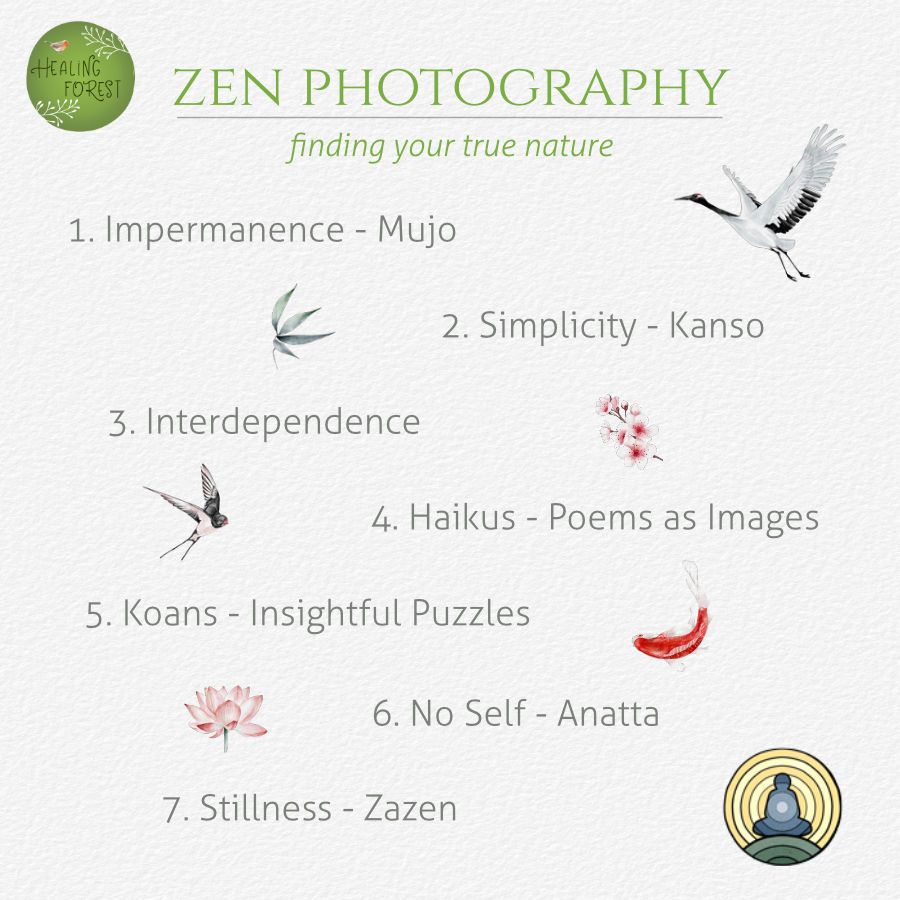
1. Impermanence (Mujo)

Zen teaches that everything is transient, always changing, and nothing is permanent. Recognizing the impermanence of life encourages us to appreciate each moment deeply, knowing it will soon pass.

Photography Prompt: Capture a moment of change—like a wilting flower, a setting sun, or the shifting tide. Highlight the beauty of transition and the fleeting nature of all things.

2. Simplicity (Kanso)

Simplicity in Zen emphasizes the importance of minimalism and clarity. Stripping away excess and focusing on what is essential allows the true nature of things to shine through.

Photography Prompt: Find a simple subject, whether it’s a single leaf, an empty road, or a lone stone. Use negative space and clean lines to highlight the simplicity of the scene, removing distractions to let the essence emerge.

3. Interdependence: Web of Life

Zen teaches that all things are interconnected and arise in relation to one another. Every element, every being, and every moment influences the whole, creating a web of interdependence. Recognizing this interdependence teaches us to approach life with reverence and humility, seeing beauty in the smallest details and their connection to the larger world.

Photography Prompt: Capture a scene where multiple elements come together to form a whole—like the branches of a tree, animals in harmony, or a group of people working together. Highlight the relationship between the parts and the larger whole.

4. Haiku: A Painting in Words

A haiku is a simple yet profound Japanese poetic form that captures a fleeting moment in nature or life, evoking a deep sense of presence. Typically written in three lines with a 5-7-5 syllable structure, haiku often reflect the seasons, impermanence, and the subtle beauty of the everyday. The essence of a haiku lies in its ability to say much with little, inviting the reader to pause and feel.

“An old silent pond—
A frog jumps in,
Splash! Silence again.”

~ Matsuo Bashō

Photography Prompt: Seek out a moment in nature where stillness is briefly interrupted—a ripple in water, a bird taking flight, or leaves stirring in the wind. Capture the interplay between movement and quietness.

5. Koan: Zen Riddles

A koan is a Zen riddle or paradoxical question meant to bypass logical thought and lead to direct insight. It cannot be solved with reason; instead, it invites you to sit with the question and experience its truth intuitively.

“What is the sound of one hand clapping?” This koan invites contemplation of the limits of logic and the nature of duality. It points to the question of opposites and how they relate when one side is absent.

Photography Prompt: Look for a scene that explores duality or contrast. Perhaps a single tree standing alone against a vast sky, or the play of shadow and light. Capture the space between opposites, where one side is absent yet still present in the mind.

6. No-Self (Anatta)

In Zen, the concept of anatta suggests that there is no permanent, unchanging self. We are constantly evolving, and our sense of “self” is an illusion. Understanding this helps free us from attachment to ego and expectations.

Photography Prompt: Capture a scene where the individual is part of a larger whole. It could be a person walking in a crowded street, or someone immersed in nature. Emphasize the connection between the individual and their environment, blurring the boundaries of self.

7. Zazen: The Practice of Stillness

Zazen, the core of Zen meditation, is the practice of sitting in stillness, being fully present with whatever arises. It is not about striving for an outcome or focusing on achieving a certain state of mind, but rather about observing the thoughts and sensations that come and go without attachment. Through Zazen, we become deeply aware of the moment, letting go of distractions and returning to our true nature.

Photography Prompt:
Capture the essence of stillness. Seek a scene where tranquility and simplicity dominate—perhaps a quiet moment in nature, the calm of an empty room, or a single figure in a peaceful pose. Use the image to convey a sense of inner peace, as if time itself is still. The composition should invite the viewer to pause and breathe, echoing the stillness of Zazen.

Zen photography invites us to see that there is no separation between ourselves and the world. The sky does not merely exist above us; it breathes within us. The trees are not just silent witnesses to life; they are our companions, rooted in the same earth. Through Zen, we realize that all things—light, shadow, stillness, and movement—are interconnected, forming the fabric of existence. In photography, this oneness is felt when the camera becomes more than a tool; it becomes a way to merge with the moment. To practice Zen photography is to step into this unity, capturing not as an outsider but as one who belongs, one who is. Let every image you create remind you of this profound truth: there is no subject, no photographer—only snapshots in time.

How to use this activity: Zen photography can be practiced alone or in groups. When in a group, do the walk and sharing in silence. It’s nice to show appreciation for each others pics, but keep the conversation minimal. It helps to be more present to what’s happening within us and around us. Another creative way is to share this page with your close friends who may be in different cities. Fix a time to do the walk and share your pics with each other online.

~ Sengt’ san

What Next
For those who wish to go deeper into a journey of self-discovery, there are hundreds of possibilities and nature offers some of the simplest, yet most effective options. Try our collection of insightful activities from around the world here: Nature Calm

Visit our main page to learn how forests heal people: Healing Forest

How can we learn meditation with nature? Most people have an incomplete picture of what meditation is. Many have tried and given up on meditation. In this post we present a unique approach to meditation through nature. We’ll use simple short nature films to guide your meditation, helping you reach deeper states of the mind as well as creating fresh new insights for your life.

The most common perception of meditation is that it is about sitting in one place with your eyes closed, spine straight and trying to observe your thoughts or your breath. A lot of people try to free their mind of all thoughts, which is extremely challenging so they give up. Many try to fix their thoughts using the breath or a chant, but for overactive minds sometimes the process gets tiring or boring. However, there are hundreds of fresh possibilities for meditation if we can understand the goal of meditation.

One of the most important goals of nature meditation is to be free of thoughts that limit you. The initial stages start with focus and attention. As you go deeper the practise yields new awareness and insights. And finally, we understand how to transform these insights into our way of being as well as our actions. So in simple terms, attention yields awareness and awareness leads to action.

In this article we will take you through 5 short films from amazing nature spaces around the world. The films will transport you to surreal landscapes that fix your attention. Each film also reveals an enquiry into our inner nature. Under each film are the nature meditation prompts for you to grow your awareness. For the best viewing experience watch on full screen mode with headphones.

Sit with a pen and notebook as you watch these films. After each film, take a few minutes to reflect on the nature meditation. Write down important thoughts that come to you and areas of your own life that you can apply them to. As an added bonus, share these nature meditations with someone close to you and then find time to discuss each other’s insights. This will create rich conversations and priceless treasures of learning from each other.

Forest Meditation
Imagine yourself in the vastness of nature, surrounded by its stillness and beauty. If you could be one thing in nature, what would you be? Picture it vividly. Would you be a tall, grounded tree, offering shade and shelter, rooted deeply into the earth? Or perhaps a flowing river, gently carving its path, moving freely yet with purpose? Maybe a cloud, softly drifting, watching the world from above without attachment?

Whatever you choose, reflect on why. What draws you to this form? Is it the stability, the freedom, or the sense of harmony? Let your choice reveal something about your inner self, your desires, and your nature.

As you breathe in, connect to the essence of this natural form. As you breathe out, release any tension or resistance. Allow yourself to feel that you are this part of nature—connected, alive, and whole. Stay here, breathing, connected to your chosen form, feeling the wisdom and peace of nature within you.

Nature Meditation
Ask yourself: What are you seeking from life? What deep desire, longing, or purpose quietly stirs within you, like a seed waiting to grow? Is it peace, love, understanding, or something else? Allow this question to settle into your heart, as softly as sunlight filtering through the trees.

If you could ask the universe one question, what would it be? Picture yourself wandering through a forest, each step revealing a path, each breath filling you with curiosity and wonder. As you walk, you carry this question with you, not as a burden but as a companion—guiding you.

Let your thoughts flow like a stream, without rushing. Perhaps you seek to understand your place in this world, or how to cultivate deeper joy, or maybe it’s the mystery of how to truly love and be loved. Whatever the question is, hold it gently, like a fragile leaf resting in your palm.

Nature Meditation
Reflect on the phrase: “From nothing, into nothing.” Just as the forest comes alive from seed to tree and eventually returns to the earth, life itself rises and falls in its own rhythm. What does this mean for you? Can you find peace in the ebb and flow, knowing that everything is part of this endless, beautiful cycle?

As you reflect on the forest’s cycle, consider the art of letting go. The trees do not cling to their leaves when it’s time for them to fall. They release, trusting that in letting go, they make space for new growth. In the same way, can you release your attachments—whether to moments, people, or expectations—and trust the natural flow of life? By letting go, you free yourself to grow and change, just as nature does.

Breathe in this sense of release, and breathe out anything you’re ready to let go of.

Nature Meditation
What does learning to fly mean for you? Perhaps it’s stepping into freedom, embracing change, or trusting your own strength to carry you. Feel what it would be like to spread your wings, leaving behind the safety of the branch to soar into the unknown. What does this flight represent for your life?

Now ask yourself: What is stopping you? Is it fear of falling, self-doubt, or holding on too tightly to what you know? Breathe in deeply, feeling the strength within you, and breathe out, releasing the fears or obstacles that hold you back. Trust that you have everything you need to fly.

Nature Meditation
If you could dream up a future for humanity, what would it look like? Imagine a world shaped by your deepest hopes—what values would guide us? How would people live with one another, with nature, with themselves?

Now, ask yourself: How would you go about achieving this vision? What steps, however small, can you take in your daily life to bring this dream closer? Is it through changing how you connect with others, choosing more mindful actions, or perhaps advocating for causes that matter to you? What is within your reach today that could begin to shape the world tomorrow?

Breathe in the possibility of this future. Breathe out, letting go of any overwhelm. Trust that even the smallest steps can ripple out, like a drop of rain feeding an entire forest. Stay with the feeling of possibility and purpose.

Hi, my name is Nitin and I am the founder of this Healing Forest website. In my free time I like to create uncommon stories from extraordinary places. You can see more of my work on Youtube or Instagram or Amazon. I hope these short nature meditations brought you some calm amidst the chaos of our world.

What Next
For those who wish to go deeper into nature meditation, there are hundreds of possibilities and nature offers some of the simplest, yet most effective options. Try our collection of nature meditations from around the world here: Nature Calm

Please leave a comment if you can, to add your thoughts to the conversation.

Europe is home to some of the most beautiful forests, each offering a unique experience. This month we have created a list of seven enchanting forests in Europe which are especially suited for forest bathing and a mindful connection with nature.

Forest bathing, or “Shinrin-yoku,” is the practice of connecting with nature to enhance our well-being in a way that transforms not just our mind and body but also our relationships. Read our introductory article to get a deeper insight into forest bathing.

1. Black Forest, Germany

The Black Forest, or Schwarzwald, is a vast expanse of dense woods, rolling hills, and idyllic villages. Its deep, dark canopy and intertwining trails make it perfect for a peaceful forest bath. As you walk through the forest, you can hear the gentle rustle of leaves, the chirping of birds, and the distant flow of streams. The forest is also known for its therapeutic springs and serene lakes, offering a full sensory experience.

Pic by Daniel Rauber
  • What’s Special: Dense canopy, charming villages, therapeutic springs.
  • Best Time to Visit: Late spring to early autumn (May to September) when the weather is mild and the forest is lush and green.
  • Forest Information Link

2. Hallerbos (Blue Forest), Belgium

Hallerbos, also known as the Blue Forest, is famous for its stunning bluebell bloom every spring. For a few weeks, the forest floor transforms into a sea of vibrant blue, creating a magical atmosphere perfect for a calming walk. The towering beech trees provide a lush canopy, while the gentle fragrance of bluebells fills the air, making it a unique and enchanting destination for forest bathing.

  • What’s Special: Carpet of bluebells in spring, vibrant and fragrant.
  • Best Time to Visit: Mid-April to early May, when the bluebells are in full bloom.
  • Forest Information Link

3. Forêt de Brocéliande, France

The Forêt de Brocéliande is steeped in mystery and legend, believed to be the mythical home of Merlin the Wizard from Arthurian legend. This forest offers a magical ambiance with its ancient trees, hidden ponds, and misty atmosphere. Walking through Brocéliande feels like stepping into a fairy tale, making it an ideal place for a meditative forest bath.

  • What’s Special: Arthurian legends, mystical ambiance, ancient trees.
  • Best Time to Visit: Autumn (September to November) when the forest is adorned with colorful foliage.
  • Forest Information Link

4. Plitvice Lakes National Park, Croatia

While famous for its cascading lakes and waterfalls, Plitvice Lakes National Park is also surrounded by lush forests that provide a perfect setting for forest bathing. The forest trails lead you through rich greenery, where you can enjoy the soothing sounds of flowing water and the refreshing scent of pine and beech trees.

  • What’s Special: Lush greenery, waterfalls, diverse flora.
  • Best Time to Visit: Spring (April to June) or autumn (September to October) for mild weather and fewer crowds.
  • Forest Information Link

5. Ancient Caledonian Forest, Scotland

The Ancient Caledonian Forest is a remnant of the vast forest that once covered much of Scotland. It is home to rare wildlife and ancient Scots pine trees that are hundreds of years old. This forest offers a sense of solitude and timelessness, making it perfect for those looking to reconnect with nature and find peace among the trees.

Pic by Paul Tomkins
  • What’s Special: Ancient pine trees, rare wildlife, solitude.
  • Best Time to Visit: Late spring to early summer (May to July) when the forest is in full bloom and wildlife is most active.
  • Forest Information Link

6. Biogradska Gora, Montenegro

Biogradska Gora is one of Europe’s last remaining primeval forests, characterized by ancient trees, glacial lakes, and rich biodiversity. The untouched nature of this forest offers a serene and pristine environment for forest bathing. The air is crisp and clean, and the dense canopy provides a cool, shaded retreat, making it a perfect place to unwind and relax.

Pic by Uliana Sova
  • What’s Special: Primeval forest, glacial lakes, rich biodiversity.
  • Best Time to Visit: Summer (June to August) when the weather is warm and the forest is at its greenest.
  • Forest Information Link

7. Vikos Gorge Forest, Greece

Located in the Pindus Mountains, the Vikos Gorge Forest is part of one of the world’s deepest gorges. The surrounding forest offers breathtaking views, rich vegetation, and a tranquil atmosphere, ideal for forest bathing. Walking through this forest provides a unique combination of rugged natural beauty and peaceful serenity, making it a memorable experience.

  • What’s Special: Deep gorge, stunning views, tranquil atmosphere.
  • Best Time to Visit: Spring (April to June) or autumn (September to October) for comfortable temperatures and vivid landscapes.
  • Forest Information Link

Bonus: Forest Bathing in Finland

A short 2 minute film from the forests of Finland that captures the essence of Forest Bathing.

There are hundreds of breathtaking forests spread across Europe – and each one offers something special. We only chose a few to get you inspired. If you know of other exceptionally beautiful forests, please let us know in the comments section.

Every month we share uplifting new ideas from nature. You can join our free newsletter to see older posts and get the latest one.

Also, try our collection of best forest bathing activities to make your world wonderful >> Nature Calm