CREATIVE WRITING EXERCISES IN NATURE

Writing is therapeutic. Writing in nature – meditative.

Writing helps to give direction to our thoughts. From clouds of voluminous chatter in the mind, words drop on to paper like gentle rain, turning into streams of sentences. These streams follow their own path to uncover what is hidden and discover what is waiting to be discovered. It is a way to ignite creativity, curiosity and a deeper enquiry into the self.

It’s about observing the nature outside and observing the nature within.

Writing about nature leads to an increased awareness of our surroundings. This simple activity is an exercise to enhance our attention and also become aware of our own state of being. Nature is a place where one can observe our outer and inner landscape. Every person has a unique way of perceiving life and things around them. You begin to discover this uniqueness when you channelise your memories and imagination in a creative way.
forest-element-heart

Writing in nature is also a way to reconnect to a calmer self. Putting words on paper brings us back into the present moment and by paying attention to our senses and breath we can reach a state of relaxed ease. When one is relaxed and calm, it is easier to get creative insights about the questions in our mind.
writers-walk-hf

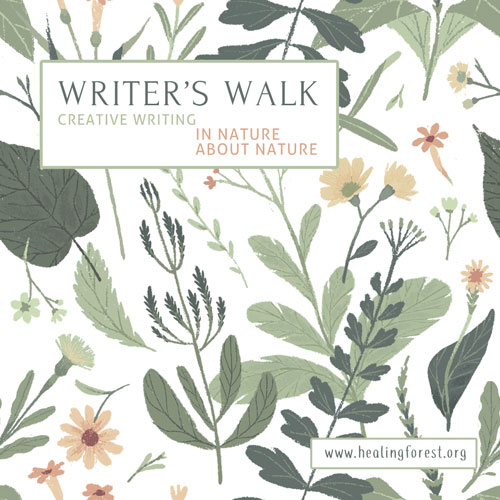
WRITING EXERCISES IN NATURE

Our mind is a forest of memories, ideas, and observations. Let us explore the power of words to rediscover the nature around us and the nature within us.

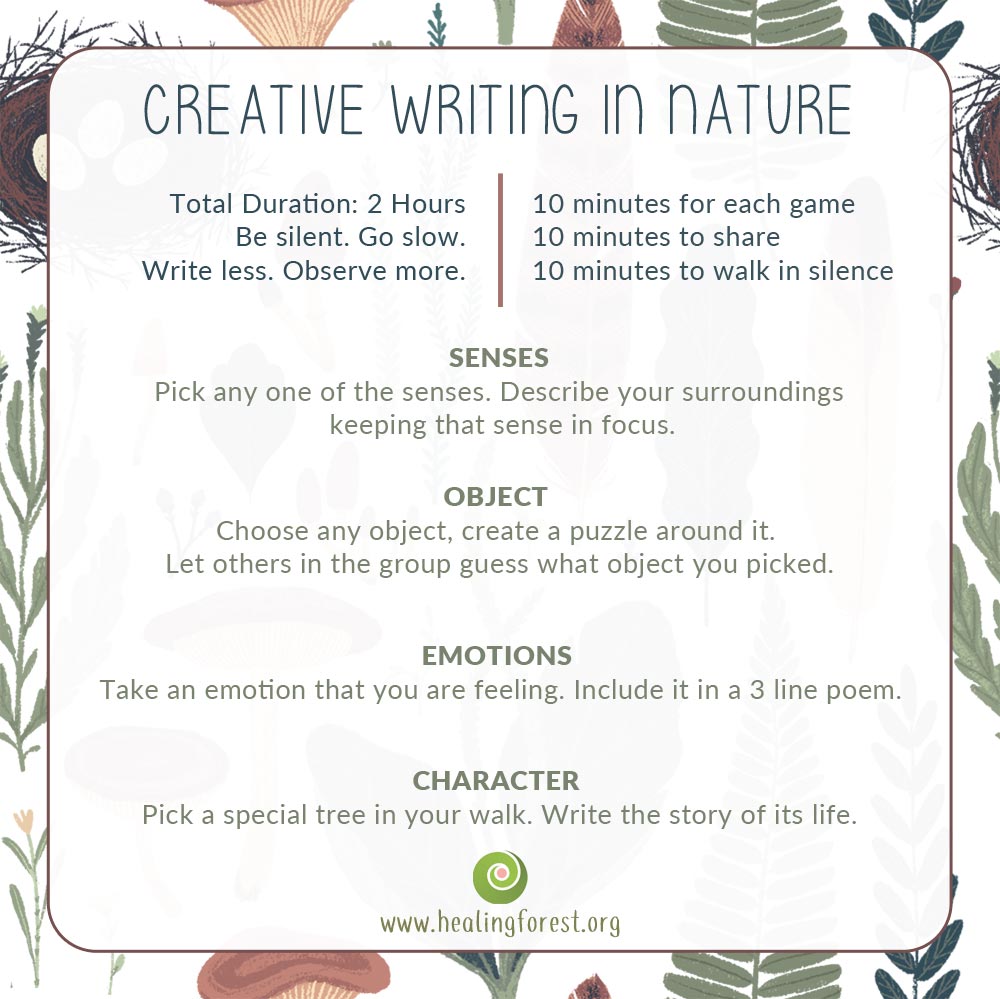
Given below is a list of simple writing games that can be incorporated into an engaging walk for all age groups. The aim of these games is to build your awareness and curiosity. We hope this practice leads you to calm, creativity and clarity.

Senses: Pick any one of your senses. Describe your surroundings keeping only the chosen sense in focus. You can turn this exercise into a letter to a friend. In the letter you are describing your nature walk to a close friend who is not present with you, but remember you can only use one sense to portray the scene.

Objects: Choose any object in nature, create a riddle around it. Let others in the group guess what object you picked. In the riddle the less you reveal, the more interesting it becomes. Just like the language of the forest which is full of riddles and mysteries.
Here’s a riddle for you. The answer is given at the very end of the article.

You can see me, but you can’t hear me.
You can feel me, but you can’t smell me.
What am I?

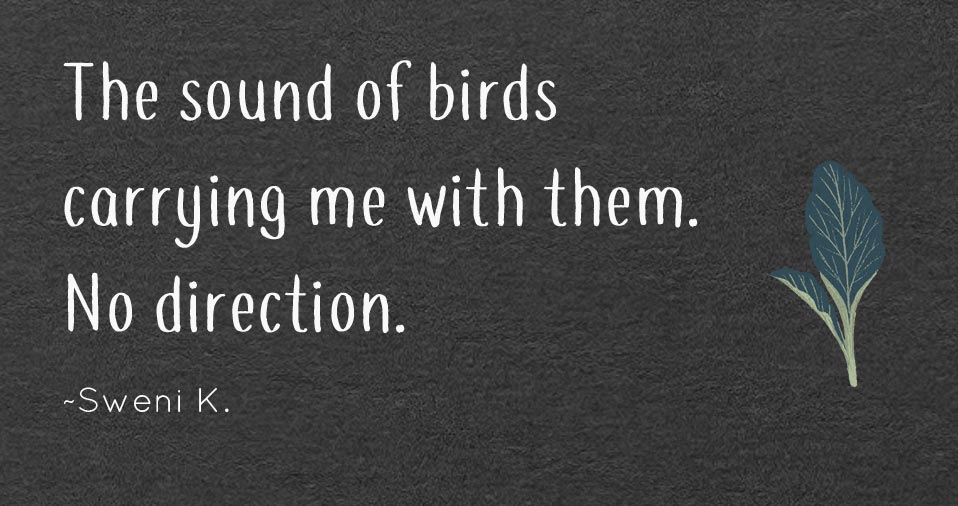
Emotions: Take an emotion that you are feeling. Include it in a 3 line poem. These 3 line poems are a simplified version of Japanese Haikus. The aim of our poem is to capture an image from your nature walk and convey the emotion you are left with. It’s not a test of your poetic skills and the lines do not have to rhyme. Here’s an example:
Characters: Pick the oldest tree around or a tree that feels special to you. Spend time with it and write the story of its life. In this exercise allow your imagination to fly. You can compress time and write a biography for the tree or simply write about a day in the life of your tree.

forest-element71s

EXTRAS: IDEAS FOR NATURE WRITING

Magical Creatures: Our forest stories have always been full of magical beings like elves, fairies, gnomes. If you could create your own magical creature what would it be? What magic will they have and what would you call them?

Game of Memories: When we recollect positive memories in nature it strengthens them and allows us to return to them when we need it the most. Write down your earliest happy memory. Write down your most peaceful nature memory.

Nature Song: This is a fun exercise that gives rest to the logical, thinking side of your brain. Pay attention to the sounds of nature and write a song in gibberish. Which means you cannot use any known words from your language. Just compose a song from the sounds around you: Krr Krr Krr Krr Krr, tok tok, Ku-oo

One Word Connections: This game serves as a warm-up to our next exercise, but is also fun on it’s own. If you are in a group, form a small circle. The game starts by one person saying any word from nature. The next person says the first thing that comes to mind on hearing that word. You are not allowed to think and respond. If a participant takes too long to respond, then the chance automatically passes to the next person in the circle. Complete 2 to 3 rounds of the circle with this exercise and build your spontaneity.

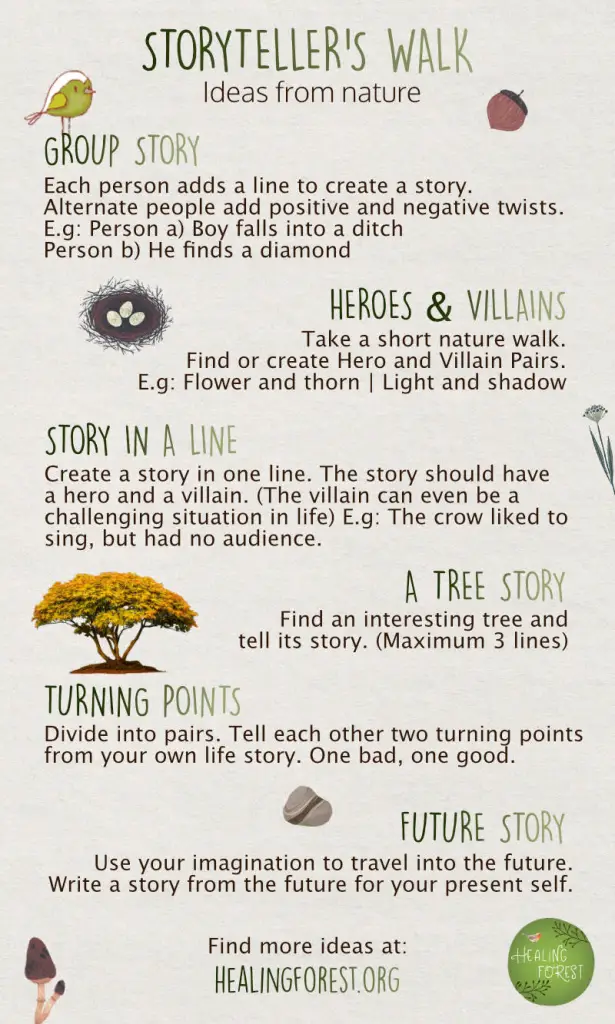
Twisty Tale: This is a group exercise. Stand in a circle and create a story starting with ‘I went for a walk into the forest….’. The conditions are that each person adds one line to the story, but alternate people add happy and sad twists to the story. So one set of people are trying to make the story positive and happy while the other set is giving it a dark or tragic turn. Once the story runs its course, switch the roles of the people.
Gratitude Note (Closing Exercise)

We usually end our nature walk by writing a note of gratitude. The note starts with gratitude for the gifts we have received from nature and grows to encompass other aspects of our life.

Without gratitude, nothing is enough

~Julio Olalla

At the core of all emotions in life, this emotion of gratitude is the one that allows us to find contentment and make peace with ourselves. It shifts focus from what is missing within our life and moves our heart to appreciate what we have.

As with all writing, this exercise is effective only when the words flow from the heart and not the head. We hope that being in nature has enabled you to do so.
Games-writers

Bonus: Story Walk

A story walk session typically takes about 60~90 minutes. It is suitable for all age groups and creates more delightful results when people of different ages participate together.

Give around 15 minutes for each activity – 10 minutes for exploring, walking, writing and 5 minutes for sharing the stories. If there are a large number of participants, create smaller groups of 5 or less for sharing. Smaller groups create more meaningful engagements.

Any safe space in nature works for a story walk. Make pairs to create responsibility and manage the group better. At the end of each activity, have pre-decided meeting points for sharing stories from that section. These ideas are mere suggestions. Feel free to make your own. Stay creative.
WORDS THAT HEAL

Please share this article with friends who may find it useful. Here’s a link to download some posters, in case you’d like to create an event for people in your city.

Fewer people are spending time in nature these days. This distance is affecting our health – as individuals, as a society and also as a planet. The intention of this idea is to bring nature back into conversations and inspire more people to connect with forests in creative ways. Let’s do this as a collective.

When you create writing in nature and share it with other, it spreads the seeds of emotions you felt and the insights you learnt. Hopefully, it will grow the magic of nature and draw more people to it.

Do share your poems, puzzles, stories or reflections from the nature walk on our Facebook group. In case you post your writing on social media, add these tags: #healingforest / #forestlearning. It will make it easier for us to find them.

*This page is part of our learning program with nature arts, activities and meditations from around the world.

48-acorn

END NOTE:
To get uplifting new ideas once a month you can join our free newsletter here. We are a small group of friends trying to find new ways to reconnect people with nature. Our aim is simple. Helping people heal. Helping forests heal.

We’d love to hear your thoughts, experiences, and suggestions for more writing games. Please add them in the comments section below to grow our collective learning.
flowers

p.s: Our answer to the riddle is ‘Sunlight‘. But in nature, there can be more than one right answer!
Our world is made up of relationships.

In life, we are constantly moving through a sea of changing relationships – not only with other lives, but also with our surrounding environment and most importantly, with our own changing selves. Sometimes, when life takes a wrong turn and one ends up in an unhappy place, it can be a good practice to re-examine and re-look at our relationships.

Nature is a great place to untangle our thoughts and find fresh perspectives. It’s because in nature, all the mysteries of life unfold before us. All we heave to do is learn to observe and become aware. In this month’s guest post, Katriina Kilpi from Belgium shares some beautiful insights from her own trysts with nature.

Berries

ABOUT
Katriina Kilpi leads a NatureMinded consultancy that works to research and promote nature´s wellbeing effects on humans; a Forest Mind guide, and a student at the Swedish University of Agricultural Sciences in program about Outdoor Environments for Health and Wellbeing. This summer she is co-organizing the first ‘International Forest Therapy Days’ event to help connect and promote the important work of forest therapy practitioners and scientists around the world. She is an expat Finn who has found her magical forest in the scarcely forested Belgium.
https://natureminded.be
 | http://www.forestmind.be | http://www.foresttherapydays.com

LeafWhat can nature teach us about relationships?
There’s this place in my favourite forest, where big old beeches grow. It´s a special spot, because at the bottom of those beeches, there grows a thick layer of moss.

This is the place where I go to when I feel like I can’t handle it alone. When I need to be held like a baby. I go and lean against one of those beeches, with my feet pressed into the soft moss, and I swear, the tree closes in on me, like arms reaching around to hold me.  I feel listened to, without any words being exchanged, and I feel consoled. There’s no judging. Only acceptance and compassion. As a thank you for listening, I value this forest, and do my best to protect it now and in the future. It’s probably exactly what the tree would want from me. A perfect exchange for our friendship.

Successful relationships are formed for mutual benefit.

moss-3
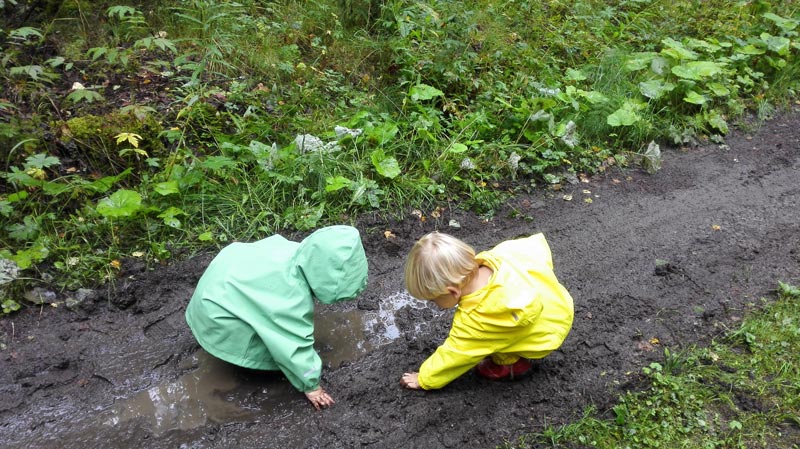
My son has also established a relationship with his nearby nature. One day he pointed out to me that of the two bushes next to his tree house, one was a nice one while the other was a naughty one. Maybe the thorns in the naughty bush has something to do with his judgement. So, according to this little man, the bushes not only have their own personalities, but he has also established a relationship with the bushes (one that is less close, obviously).

We quickly judge the personality of someone based on their behaviour towards us. A greater understanding would develop if we realise that personalities and qualities are shaped by the outer environment as well as the inner genetic make-up. In the design of nature, each and every life form has a unique role to play.

So for a deeper relationship to develop, one must start with a better sense of observation.

Kids

For the creatures or people, we do know, we often overlook their value and start taking them for granted. It doesn’t dawn to us that we are taking these people (or creatures) for granted before someone else recognises their uniqueness or, what’s worse, before we lose them. I once moved to Hawaii and found the myna birds, with their oversized heads and their yellow masks, rather comical looking. To me they looked funny and mischievous, always up to no good. I liked those birds. After some years, I had got so used to them that when my mother came to visit and wanted to photograph those little birds, I found it a waste of film. Sustaining a relationship requires a continuous effort, otherwise it loses its vitality.

Stone-1
And finally in nature and human nature, there are surprisingly many similarities. Though romantics often idealize nature, there is pain and suffering, continuous competition, sickness and loss in nature too. A relationship is incomplete without the acceptance of the imperfections.

Nature has a lot to teach us. Though we all fight for our survival: for sustenance, for shelter, for the possibility to maintain our species – the cycle of life would not be possible without interconnections, interdependence and impermanence.

Nature helps us to mirror our relationships within the human community and allows us to practice our relationship skills early on. Nature is a compassionate and patient teacher, as it doesn’t push us, but allows us to find it out ourselves. The relationship we have with nature, the backbone to our wellbeing, can teach us most about ourselves.

Walden-Quote

END NOTE:
Our world is made up of relationships. A set of intricate links and bonds, tie us to everything in this Universe. These posts on our blog are created, not just to share interesting perspectives and new findings but also to link up with you and build a community of like-minded forest friends. Know more>>.

Do share your thoughts with us in the comments section below. You can also subscribe to our monthly blog posts here. We are a small group of friends trying to find new ways to reconnect people with nature. Our aim is simple. Helping people heal. Helping forests heal.


In this article we explain the concept of nature art with some creative examples and exercises. Along with the nature art ideas we share ways to turn these walks into healing experiences.

Art can be healing, just like nature. When we create art in nature, we are connecting to something deep within ourselves. That which is the source of all ideas, inspiration and insight. It gives us new eyes to see with, new ears to hear with and a new understanding about life.

“Our life is but art in the canvas of nature.”

NATURE ART WALK

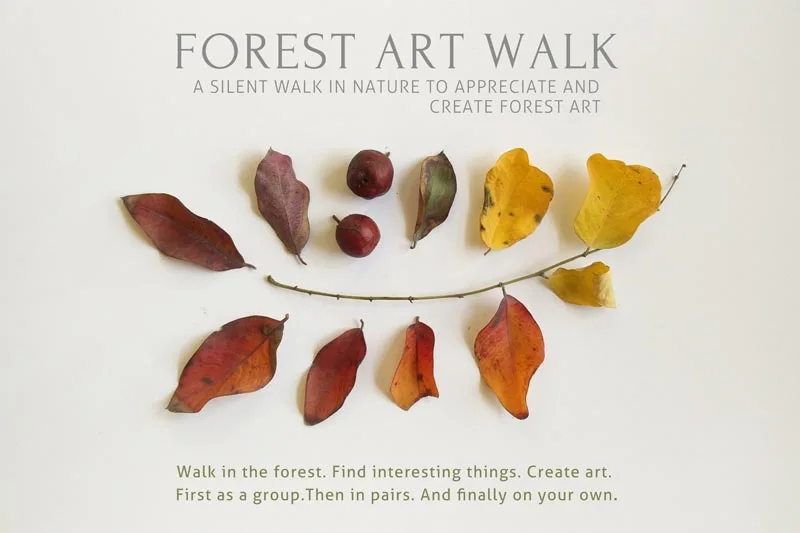
Over the course of many months and trials, we have come up with a captivating format for an art walk in nature. It is a creative way to engage with the forest and is enjoyable for all age groups. Here’s a simple introduction to the concept. It’s a silent walk in nature to appreciate the beauty of art in nature and allows us to express our emotions by creating some interesting forest art. 

Walk in the forest. Find interesting things. Create art.
First as a group. Then in pairs. And finally on your own.

RULES
1: Don’t damage the forest. Use what’s fallen or about to fall.
2: Take only pictures. Let everything you create, return back to nature.
3: Leave no trace. Spread your artwork in nature before you leave.

Nature Art Directions

Group art:
To begin with, explore a small circle of forest area around you. Everyone tries to look for something that represents them as a person or something unique. When ready, the group forms a circle to do a round of introductions. People introduce themselves by placing their object in the centre of the circle and explaining why they chose it. One by one, the objects are placed together in a way that they form an art piece.

After the first round, the group walks silently for 15 minutes or so and moves to a different place.

Pair art:
Work in pairs. The pair collects 10 objects from the forest ( 5 per person) and together they create nature art in 5 minutes. Once everyone is ready, the whole group goes for a gallery walk to visit each pair’s artwork. You can try to guess what the pair has made or hear their interpretation.

Walk silently for 15 minutes. Observe the beautiful art of Nature.

Solo art:
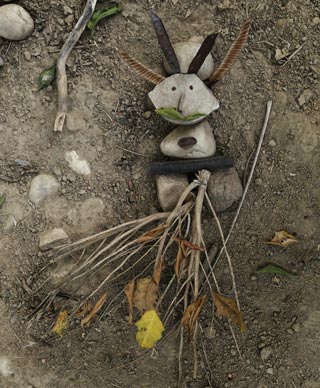
Working on your own, you have to create a forest friend. A piece of nature art, that has a face on it – eyes, nose, mouth. Once your forest friend is complete, give him/her a name. When this exercise is complete, you will find that the forest has suddenly come alive with many forest friends.

INSIGHT: These forest art exercises tell us that it’s our mind which gives meaning to art. People look at the same arrangement of objects, but everyone interprets it differently.

In the canvas of nature, our life is also like art. Nature brings different situations and people into our lives, but it is our mind which gives meaning to these events. It is this meaning which makes us happy or sad. The entire journey of healing is in being able to observe and transform the art in our mind.

On your way back, walk in silence and observe the art of your mind and the meanings that your mind has given to your life. For a few moments, can you drop all the meanings that your mind has created and simply observe and appreciate nature and its art?

End with a circle of sharing. People share insights and experiences from the art walk, so that individual learning can become collective learning.

Bonus:
Carry an empty bag on the walk. On the way back, the group can clean up the forest by clearing some of the trash they find. Healing the forest is a healing experience too.

EXTRAS – Art in Nature

Colour and Mood:
Choose any colour and collect objects in nature with that colour shade. Create a colour palette with all the different shades of your chosen colour. What are the memories, people and things you associate with that colour? Create a list of all things that come to mind when you see that colour.
*This exercise has been contributed by Mai Ly Tran a school teacher from Vietnam

Creative Visualisation (Nature’s Gift):
Collect an interesting object from nature. Use creative visualisation to turn this object into something else. For e.g: A long stick may become a flying broom, or a microphone stand or a paddle for a boat. Visualise at-least 5 to 10 different things with your chosen object. If you are in a group, then divide into pairs. Each person finds a nature gift for their partner. Visualise a creative use for the gift you have received. Enact it out while other group members try to guess what you are using your object as.

Concentric Circles:
This exercise is designed to build patience and focus. A highly calming nature art activity is to create spirals or circles with nature objects. Start by collecting similar objects like sticks, stones or fallen leaves. Create a small circle with a few objects from your collection. Keep growing your art by adding bigger concentric circles around the original circle. Each of the circles can be of a different colour / size / shape.

forest-element-twig

Nature Art: Tips From Rocks

Nature Art
*Download nature art walk poster files and film at the end of this article.

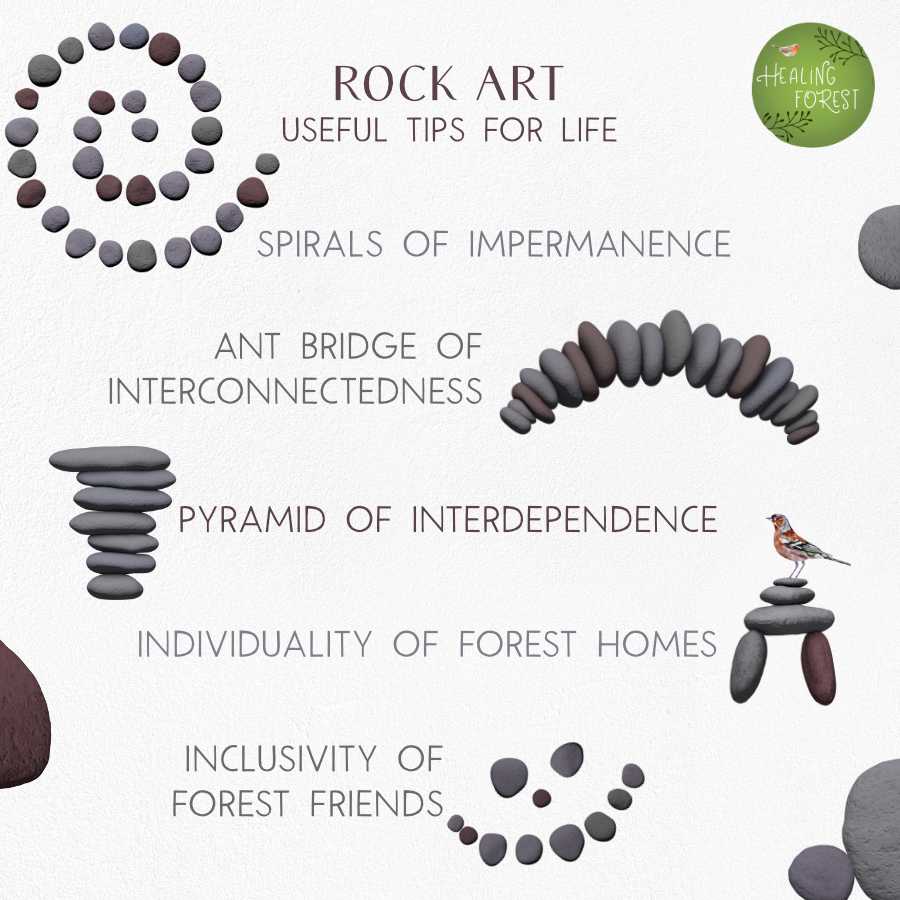
Imagine, if we could learn the principles of design from nature. Would it change the way we make decisions for our life? In this variation of a nature art walk, we collect rocks and pebbles to learn 5 important principles of life. The tasks are as follows:

Impermanence: Create 2 interlocked spirals.
Spirals can be metaphors for our life’s journey. Observe how everything has a beginning and an end.

Interconnectedness: Make a bridge for ants.
In Nature’s art everything is interconnected. Creating bridges is training for the mind, to look for creative solutions to fill the gaps in our life.

Interdependence: Build an inverted pyramid.
The secret of designing an inverted pyramid is to create proper support. The art of nature is filled with invisible relationships that support each other.

Individuality: Build a forest home.
Notice how for every individual, certain values hold greater importance over others. The designs they create and the decisions they make stem from these values.

Inclusivity: Bring a magical forest creature to life.
Try this activity in small groups. Including others in the art process can sometimes be a bit challenging. Especially if they have divergent views and personalities. However, nature teaches us that greater diversity yields richer benefits.

Nature Art and Life

Those who learn to observe nature, notice a beautiful balance that exists in all its designs. A harmony that has been crafted to perfection over an ocean of time. But Nature is never at rest. Just like our mind. Constantly changing. Constantly evolving.

Nature Art Film

ART AND NATURE

Please try this nature art walk with your friends and family. Even more importantly, teach others and share this format in your circles. Forests all over the world are fading away. We need to recreate our relationship with nature urgently. While science can help us create a better life, we need art to create a better world.

The idea is simple and engaging for all age groups. People across the world have held forest art walks in their cities. The aim is to share beautiful images of forest art so that we can inspire more people to connect with nature.

Join our facebook group – ART of NATURE to share your art and link up with like-minded folks from different forests and cities of the world.

Nature Art Quote

Uplift your life with nature:
Join our free newsletter

SCIENCE OF NATURE ART WALKS

When we move in any environment, we are activating different networks in our brain. There is the logical, information processing, decision-making executive network. Then there is the network, which keeps us balanced and oriented and finally the default network.

The default network is our free mind, which wanders here and there. It kicks in when your task-based executive network begins to rest. The default network is also credited with producing empathy, creativity and important insights.

A great nature experience allows the executive network of the brain to rest and recharge itself. It also engages the default network of the mind in a positive way.

Scientists using brain imaging techniques to study the effect of nature on our brain found a specific part of the brain being activated when we are relaxed in nature. This region is directly linked to the dopamine reward system of the brain, which leads to a higher likelihood of people forming emotional bonds – not just with other people, but also with nature. This has proved to be an incredible finding.

“We can create art out of anything, including our life.”

*This page is part of our Nature Calm course with 150+ nature based arts, games, and meditations from around the world.

48-acorn

Please share this page, so it reaches where it’s needed. We are a small group of friends trying to help people reconnect with nature. Our aim is simple: Helping people heal. Helping forests heal.

Download nature art walk film and poster files at this link.