
From Chaos To Calm

As we sail the ocean of life, sometimes we can run into an island of trash. Chaos is an inevitable part of this journey – so how do you clear the mind in a natural, healthy way? In this post you’ll find a creative alternative for facing your confusions, and keeping your mind clear.

A Ploem walk is a unique way of clearing up inner as well as outer spaces. Just like plogging is a combination of picking up litter while jogging – a Ploem walk combines word games with picking up litter. The simple act of healing the outer can become the path for transforming the inner – one small act at a time. Adding stories and poems to the process taps into our deepest emotions, so that the chaos inside can turn into words which create a calm and clear mind.
Simplest Way To A Clear Mind?

Do you know what are the biggest reasons for not addressing chaotic situations in one’s own life? Most people are not aware of how to handle the challenge, but also fail to gauge the negative impact of ignoring their mental health. There are many other reasons, some of which are listed below. If you look closely, these are the same reasons for people not participating in clean-up drives or other community initiatives. Is it a co-incidence?
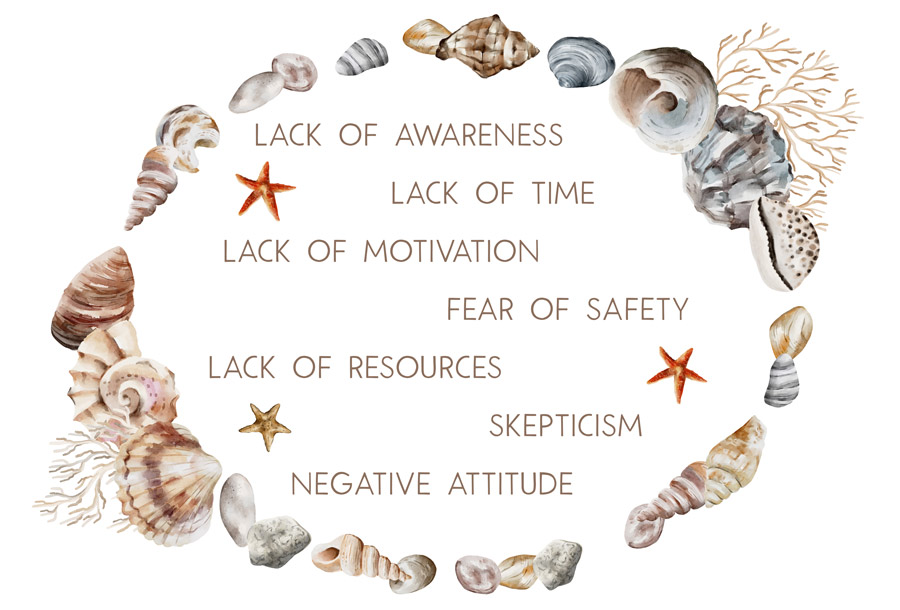
Just like adding music to a celebration brings it alive, mixing a creative angle to any difficult task makes it more engaging. The Ploem walks allow us to let go of negative thoughts and replace them with a clean and clear mind. These simple but fun activities will aid you in clearing the clutter inside your head, and creating a calm space for something useful to grow in it.
This article is part of our 12 magical walks that gift you highly useful skills for life’s adventures: Nature Play>>

Clear Mind & Ploem Walks

To start off, determine the area that needs to be cleaned and get the necessary approvals if required. Fix a date and time for the cleanup. Weekends and 2 hour slots work best. Recruit volunteers through various means, and ask them to bring a trash bag, gloves, drinking water. Keep some first aid handy. (You can even try it in your own garden to start off.)

Before the actual cleanup, the group assembles in a circle and creates the repair story.

Repair Game: In a repair story alternate members add positive and negative twists to a story. The group leader starts the story with a sentence. Moving clockwise, the next person in the circle gives the story a negative turn. However, their neighbour has to lift the story up again by making something positive happen. So the story moves in twists and turns – between good and bad, until the circle is completed.

Example: Jim got lost in the forest. > But he stumbled upon a magical waterfall. > Unfortunately, he had never learned to swim. > So he sat down and composed a beautiful song instead. > A gang of ruffians heard him singing and came to rob him. > One of the gang members turned out to be his long lost love from high school…. and so on.

This ‘Repair’ game is a metaphor for the clean-up drive. Things may appear challenging when we start, but a few well intentioned people can turn things around and start the process of healing, no matter how daunting the task.
Divide the group into pairs and start the cleaning activity for 30 – 45 minutes. Also assign roles such as team leaders responsible for smaller groups and safety officers. At a pre-determined time and place the group assembles again to take a break and play the following games.

Reduce Game: Ask participants to imagine they are going on a camping trip and can only bring 5 items with them. They must choose wisely and think about how to reduce their waste and environmental impact. In the next round, they have to go hiking and can carry only 2 out of the 5 things. Then on the hike they get separated from the group and are left with only one thing. What is that one thing they will hold on to?

Recycle Game: Ask people to use the alphabets in their own name to create other words. This activity can also be done in pairs where each pair is asked to use some letters from their first names to come up with new words.

The first step in clearing our mind is to reduce the clutter inside. Setting priorities provides a sense of direction and focus. When we identify what’s most important, we can let go of non-essential things. Also learning to sort our thoughts and rearrange them teaches us to look at our problems in creative ways. These two simple games can be useful training to keep our mind clear. Prioritising and rearranging leads to reduced stress and anxiety, and increases our productivity and overall sense of accomplishment.
Before you restart the cleanup drive again do a short nature walk to appreciate the beauty around you and recharge your inner spirit. Go slow and move in silence. Open your senses to find things that bring you peace and clear your mind. On the short walk you can try out 2 more activities.

Refuse Game: Play a game of “I Spy” where players take turns spotting something beautiful and refusing to let it get spoilt. For example, “I spy a peaceful pond, and I refuse to let it get trashed.” Each participant find something new and unique to appreciate and protect. This activity also helps us observe nature through other people’s perspective.

Reuse Game: Have participants bring in any interesting item that has been thrown away. As a group brainstorm creative ways the item can be used to give it new life. For example, an old t-shirt could be turned into a reusable shopping bag, or an old book could be transformed into a lampshade.

Clearing the mind can be a very daunting task just like cleaning our surroundings. During the process the mind can be filled with negative emotions such as sadness, anger, despair. By focusing our attention on the positive things around us we are able to channelise our energies in the right direction. Adding creativity to the task helps us look at the problem with new eyes.
Resume the clean up drive in small groups or pairs. At a predetermined time and venue get everyone together for the closing activities and sharing insights with each other.

Recover Game:  Each participant finds a spot in nature that calls out to them. They sit in silence for 5 minutes to recenter themselves. Try to recover a memory of the space before your clean-up drive and compare it with the current state. Then reimagine the entire cycle repeating. The park gets dirty again, but a few people come and clean it up.

Regift Poem: Each person chooses a spontaneous word that comes to mind from their experience at the clean up activity. Use the word in a 2 line poem or a haiku, to gift it back to the friend who paired up with them during the clean up activity.

Cleaning up the nature outside can have a profound impact on growing a clear mind. When we engage in activities such as picking up litter, planting trees or flowers, or tending to a garden, we become more mindful and present in the moment. We connect the laws that govern nature outside with the nature that’s inside us. This can lead to a deeper understanding of our interconnectedness with all living beings. It will also fill you with a sense of gratitude and compassion.

Remember to follow safety guidelines and regulations throughout the cleanup drive. After the cleanup, dispose of the collected trash in an appropriate manner. Recycle as much as possible and dispose of the rest in a designated landfill or waste disposal site.

At the end don’t forget to celebrate the success of the cleanup drive with the volunteers. Thank everyone for their participation and encourage them to recreate this activity in their own circles. In case you do try this walk out, please post some pictures on our facebook group or leave a comment below.

In the next few weeks we’ll add photos and poems sent by our readers to this page.

Clear Mind and Health

There is a strong link between a clear mind and our health. When our mind is clear and focused, we are better able to manage stress and anxiety, which can have positive effects on our physical health. Stress is a major contributor to a variety of health problems, including heart disease, diabetes, and depression. By reducing stress through practices such as mindfulness and meditation or forest bathing, we can improve our overall health and well-being.

A clear mind also allows us to make better decisions and take more effective actions towards our goals, which can have positive impacts on our physical health. For example, when we have a clear mind, we are more likely to make healthier food choices, engage in regular exercise, and get enough sleep – all of which are crucial for maintaining good health.

Additionally, a clear mind can improve our mental health, reducing symptoms of anxiety and depression, and promoting feelings of happiness and contentment. This can have a positive ripple effect on our physical, mental, and emotional well-being.
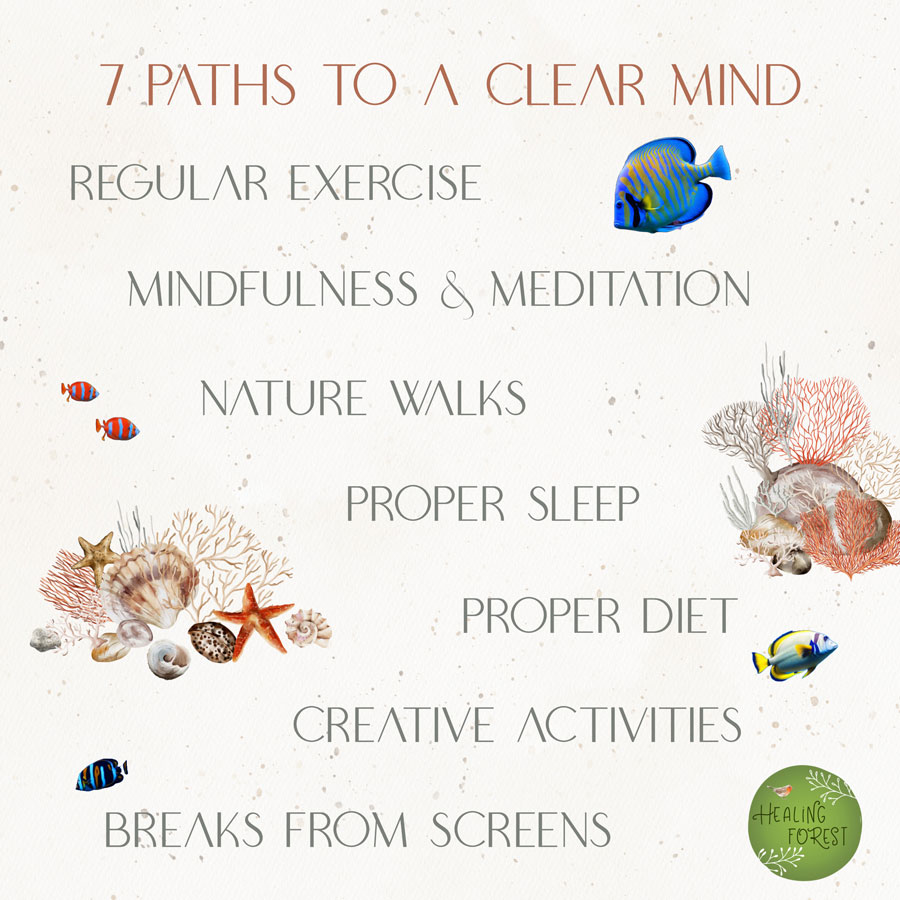
There are several effective ways to achieve a clear mind. Regular exercise, such as yoga or jogging, can help reduce stress and improve focus. Meditation and mindfulness can also be helpful, as they can quiet the mind and bring a sense of calm and clarity. Getting enough sleep, eating a balanced diet, and limiting caffeine and alcohol consumption also promotes mental clarity. It is also helpful to take breaks from technology and engage in activities that promote relaxation and creativity, such as reading, listening to music, or spending time in nature. Overall, a combination of physical activity, mindfulness practices, healthy habits, and relaxation techniques will lead you to a clear and focused mind.
Clear Mind. Earth Mind.

A clear mind is a journey, not a destination. It is the same with cleaning our planet. The Ploem walks show you how to achieve balance and harmony through play. They combine benefits from many of the activities mentioned above in a way that is also beneficial for our Earth. We hope they offer you a joyful path to a clearer mind and a cleaner environment.
To get useful new ideas once a month, join our free newsletter.

For more activities from around the world, see: Nature Calm

Healing Forest is a volunteer run project. Our goal is to bring people and forests closer to each other through creativity and mindfulness. The aim is simple. Helping people heal. Helping forests heal.

Do share this post, so it reaches where it’s needed.
Mindful Art is a unique skill for all of us, not so that we can be artists, but because drawing is another way of thinking. Just like using words is a way to think out loud on paper, mindful art is simply a way to “think” in another form.

You don’t have to be an artist to create mindful art! Drawing is something all of us have used with a pen or pencil on paper to plan, show or imagine what we are thinking. Being “good” at art doesn’t really matter as long as ideas are being shared.

In this article we show you how drawing your thoughts can be a powerful tool for improving your thinking, creativity and communication. Through the creative process of mindful art, let us explore our inner selves, access unconscious thoughts, and gain a new perspective on life.

A Zen Story On Mindful Art

Once upon a time, a Zen master was asked by a student, “Master, what is the purpose of art?” The master replied, “Art is a mirror that reflects the beauty and truth of the universe. It is a way to touch the divine and to see the world with new eyes.” The student questioned, “But master, how can I create art that is true and beautiful?” The master answered patiently, “The true artist does not seek to create something beautiful, but rather to see beauty where others do not. The true artist does not seek to express themselves, but to disappear into the work, becoming one with the universe. The true artist must first empty their mind and become like a blank canvas. Only then can the universe paint itself upon you, and only then can you create something beautiful and true.”

This story illustrates the idea that true art is not something that can be forced or created through effort, but rather it is something that comes from a state of emptiness and receptivity. The true artist is one who is able to let go of their own ego and desires and allow the universe to express itself through them.

Mindful Art Activities

You can combine these mindful art ideas with a nature walk to amplify its benefits. All you need is a pencil and a notepad to scribble your ideas. Doing these activities in a group serves to create memorable experiences and helps in bringing people closer to each other.

Mindful Art: A Page Full Of Circles
Fill a page with circles. Circles that touch each other, but don’t intersect. Add as many circles as you can within the page. Fill in the gaps in between circles with more tiny circles. You can even fill the insides of a bigger circle with smaller circles.

It is impossible to draw a perfect circle. The aim is to accept your imperfect circles, but continue to improve the skill. This mindful art of drawing circles, helps us slow down our thoughts and serves as a warmup to move on to more creative tasks.

Mindful Art: Draw Your Mood
The prompt for this exercise is very simple. If you could visualise your mood what would it look like? You can do a version of this activity before the nature walk and then at the end of the nature walk. Compare the two drawings and observe what has changed and why?

Mindful Art: Shape Of All Things
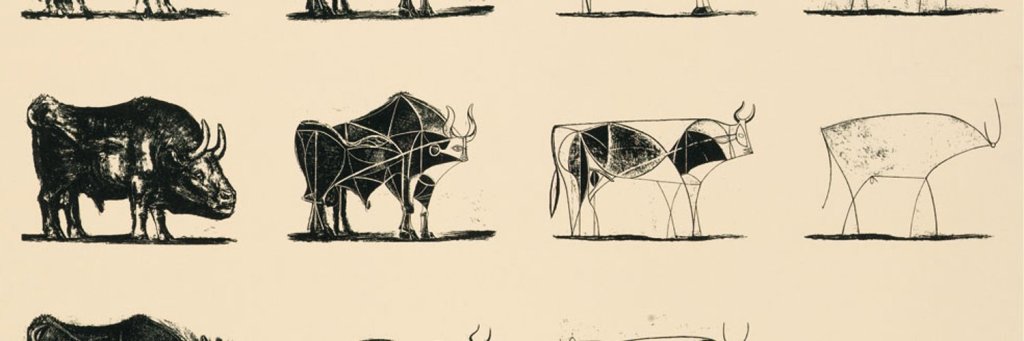
In this mindful art activity, choose any object in nature. Observe its shape carefully for some time. Try to see the fundamental geometric shapes that make up the object. For example a mountain can be drawn into a triangle. A tree can be represented with a circle and a rectangle.

Mindful art by Picasso

Mindful Art: Mind Mapping
This mindful art activity involves writing down a word or phrase that represents a current thought or emotion, then writing down other words or phrases that come to mind in response. As you write the associated words connect them with lines. See what pattern of lines emerge at the end of the activity. This exercise can help individuals to explore their thoughts and emotions in a more verbal way.

Mindful Art: Silhouettes & Shadows
For this exercise pick any interesting leaf that you find on your walk. Trace out the outline of the leaf on a black piece of paper. Use your imagination to turn this simple trace into a magical forest creature or a monster that is haunting you. You can even fill the page with traces of many different leaves and create a party of magical beings on the page.

As your imagination grows, translate the activity into your nature walk. Begin to identify magical beings and creatures in shapes of trees and rocks that you encounter on your walk. Give them names based on their unique characteristics.

Mindful Art: Drawing The Invisible
The prompt for this activity is to draw the negative space between two objects. Negative space, in art is the empty space around and between the subject(s) of an image.

Generally when we look at things we focus on the object itself. But if we expand our observation we become aware of interesting and artistically relevant shapes that surround the objects to reveal completely new things.

Mindful Art: The Tree of Life
If you were to draw your entire life in the shape of a tree, what would the tree look like? In this mindful art activity, draw an entire tree on a page with branches as well as roots. You can label the roots with values which are important to you. In the branches write down words to depict significant moments of your life. And finally represent the important people in your life as forest creatures that have a relationship with your tree of life. This activity is a beautiful way of creating a snapshot of your life’s journey so far.

Mindful art can be a powerful tool for understanding and processing thoughts and emotions, whether it’s through the process of creating art or viewing it.

Art as a mirror of the universe is a reflection of the Zen concept of unity of all things. The idea that everything is interconnected. The mindful artist is able to tap into this interconnectedness and create art that reflects the beauty and truth of the universe.

Benefits of Mindful Art

  • Mindful art helps us slow down and relax our mind.
  • It makes us better observers of our outer and inner landscapes.
  • Mindful art is an interesting way to exercise our imagination.
  • Mindful art can be a bridge between the known and the unknown – helping us tap into our subconscious mind.
  • It gives is new insight into thoughts and emotions – our own as well as that of others.
  • Above all, it is creates joy and peace.

Art therapy, a form of psychotherapy, specifically uses the process of creating art to help individuals express themselves, overcome emotional challenges and develop self-awareness. It helps individuals to understand and process their emotions, thoughts, and experiences in a non-verbal way and can be beneficial for people of all ages, abilities, and backgrounds.

Art can also help individuals understand and process difficult experiences such as trauma, grief, and loss. It can also help in dealing with mental health issues such as anxiety, depression, and PTSD. Additionally, viewing art can also be a way of gaining insight into one’s thoughts and emotions. For example, looking at a piece of art that evokes a strong emotional response can help the viewer understand and process their feelings.

Mindful Art Inspiration

For aeons humans have turned to nature and art for creativity and community. The inspiration for the mindful activities in this post comes from the fascinating cave art found around the world. Here’s a glimpse of 10 amazing examples to take you back in time.

We hope these mindful art activities take you on a creative journey to bring peace and presence in your lives. What other activities can we use to create Mindful art? Please add your thoughts in the comments to grow our collective knowledge.

*Do share this post, so it reaches where it’s needed.

To get useful new ideas once a month you can join our free newsletter. Discover amazing walks, arts, games, meditations, forests from around the world. For more amazing activities that combine creativity and nature visit or Nature Play page.

Healing Forest is a volunteer driven project. Our goal is to bring people and forests closer to each other through creativity and mindfulness. The aim is simple. Helping people heal. Helping forests heal.

The decisions we make, design our life. But seldom are we taught the invaluable skill of designing our life, often stumbling from one decision to another. 

Those who learn to observe nature, notice a beautiful balance that exists in all the designs. A harmony that has been crafted to perfection over an ocean of time. But Nature is never at rest. Just like our mind. Constantly changing. Constantly evolving.

Imagine, if we could learn the principles of design from nature. Would it change the way we make decisions for our life? Let’s try an interesting experiment in nature.  We will create some unique nature art and introduce you to the rules that guide nature’s design. Also, through short reflective walks based on the Japanese concept of Shinrin Yoku, we understand how the same rules apply to our own life.

We hope this experience lends you new insights for your decision making skills, and helps you design a life in which your inner and outer world are in tune with each other.

Nature’s Design Tips For Your Life

Design is nature’s way of problem solving. In this article we offer you some thought-provoking design challenges to grasp the art of nature’s design through hands-on activity. Each activity is followed by a short walk to deepen your experience as well as your learning.

These walks are based on the Japanese concept of mindful nature walks also known as Forest Bathing. If you haven’t already, do check out this short guide before you begin: What is forest bathing?

The aim of a mindful nature walk is to use our senses to quieten the mind. In the stillness, we gain new insights about human nature by growing our awareness of the nature outside. All activities are done in silence. Each activity is followed by a slow walk, focusing on one of our senses. The senses act as a bridge between the inner and outer.

This activity is part of our 12 uplifting walks that help us learn life’s most useful skills through nature.

Nature’s Design Tip #5: Impermanence

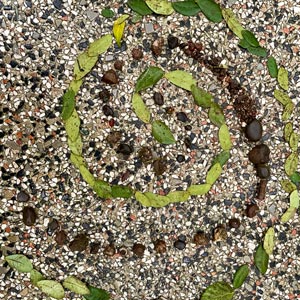
Designing 2 Spirals: For the first activity, the group is divided into pairs. Ask each participant to create a spiral from objects found in nature.  So each pair needs to create 2 interlocked spirals. Interlocked spirals enclose each other, but don’t touch each other at any point.

The spiral is a metaphor for the trajectory of our lives. As humans, we try to move in an ever expanding path of growth. However, when life ends, the spiral terminates abruptly. When we observe nature’s design, we see that things serve a purpose even in the after-life. So it starts from nothing and fades back into nothing.

Impermanence can brings a new perspective to our decisions. The ability to make a good decision is also the ability to foresee its impact in the future. Consider the 10/10/10 rule. What will be the impact of your decision 10 minutes from now, 10 months later, and after 10 years. What decisions can we take for our life’s work to have meaning, even after we are no more?

Walk: Take a 10 minute silent walk and reflect on the impermanence in nature’s design. You can walk by focusing on the sounds of nature. Start by focusing on the louder sounds, and gradually mover your attention to the more softer sounds. Every sound is a song of impermanence.

Nature’s Design Tip #4: Interconnectedness

Ant Bridge: Design a bridge for ants to cross. Find any large gap in your surroundings and build a connection so that it can serve as a bridge for ants and other tiny creatures. Only use material that can be found around you, without breaking or damaging the nearby plants. This activity is also meant to be carried out in pairs or small groups. Give bonus points for the longest bridge, and for the strongest bridge.

Bridges are metaphors for interconnectedness. Creating connection helps us get from where we are, to where we want to go. There are many times in life where we get stuck at some problem. Quite often the solution is to connect with someone who can get us out of our predicament. Bridges serve as links of exchange between us and others. Learning their importance uplifts our lives.

The design of nature is filled with invisible interconnections. For example, the roots of trees in a forest are connected to each other and communicate with each other through a network of fungi. It is this interconnectedness that allows many species to co-exist and thrive.

Walk: For this segment of the silent walk,  bring your attention to your feet and the ground beneath it. With each step become aware of how deeply we are connected to the earth.

Nature’s Design Tip #3: Interdependence

Pyramid / Inverted Pyramid: Design a pyramid made up of sticks or rocks. To make it more challenging ask the participants to design an inverted pyramid, where the base is smaller than the section on top. The task might appear a bit daunting, but the secret of designing an inverted pyramid is to create proper support. Those who can figure out the trick of supporting the heavier section will be able to overcome the difficulty of imbalance.

With new insights emerging in our theory of evolution, “survival of the fittest” theory has been transformed into “survival of the kindest.” Darwin himself wrote, “Those communities which included the greatest number of the most sympathetic members would flourish best and rear the greatest number of offspring.” What Darwin called “sympathy,”  can be termed as empathy, altruism, or compassion. According to biologists from Darwin to E. O. Wilson, compassion is the reason for both the human race’s survival and its ability to continue to thrive as a species.

Walk: Walk with your attention on the breath. Every breath we take, has come from a tree. Every breath we give, will go back to the forest. The design of nature is a delicate balance, in which how we are all interdependent.

Nature’s Design Tip #2: Individuality

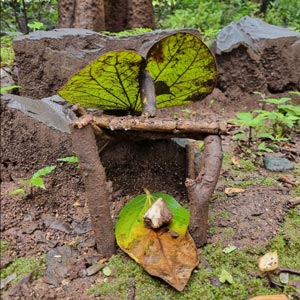
Forest House: This is a solo activity. Every participant is asked to design a tiny house for a creature of the forest. The creature could either be an animal or bird that is commonly found in the area or for a magical being like an elf or a gnome. The design of the house should reflect the needs of its occupant. The designers can even give a name to their house.

Once the houses are complete, all participants can do a quick tour of the colony of tiny homes that have sprung up. The makers explain their thought process and the most important aspect for them while designing the house.

The learning from this activity is to appreciate the uniqueness of each design. To observe how for every person, certain values hold greater importance over others. The designs they create and the decisions they make stem from these values. Nature has gifted each one of us with a unique mind. Exploring our inner world to uncover that uniqueness, can lead us to make better choices for the direction of our lives.

Walk: This segment of the walk focuses on our visual sense. Pay attention to what you see around you. Observe the uniqueness within each and every entity in nature. Becoming aware of this grand scale of nature’s design fills us with respect and humility. It makes us appreciate the individuality within others as well as within ourselves.

Nature’s Design Tip #1: Inclusivity

Forest Creature / Forest Village: This is a group activity. Divide the participants into small groups of 5 or less people. Each participant collects 10 fallen leaves and brings it to their group. The aim of each team is to design a small forest creature or a forest village using leaves to represent buildings / body parts. The teams are free to include surrounding stones or trees  as elements in their design.  Within the team, members can only speak in 1 word conversations – to elaborate what the items represent: for e.g: a school, a hospital, a park etc.

Including others in the design and decision making process can be very challenging. Especially if they have divergent views and personalities. However, nature teaches us that greater diversity yields richer benefits. In nature, biodiversity is critical for survival as it enhances the ability to face challenges and natural calamities. Similarly, bringing different ideas together allows us to create something where the whole is greater than the sum of its parts.

Walk: We close the Natures design walk, through a group sharing activity. All the participants form a circle, facing outwards – towards nature.

Sit in silence for 5-10 minutes. Observe how we are all part of nature, and how the same rules that are found in nature’s design apply to our own minds, bodies, and lives.  Let the boundaries between our inner nature and the nature outside slowly dissolve. Experience a sense of oneness.

To end the Nature’s design walk, participants can share any insights or learning from the different activities. Sharing transforms individual learning into a collective experience. On the same lines, do leave your thoughts in the comments to share any insights or observations.

The Larger Design

Some of the greatest challenges we face today are a result of designs that dictate our society’s growth. The world’s 7.6 billion people represent just 0.01% of all living things by weight, but humanity has caused the loss of 83% of all wild mammals and half of all plants.

The multiple crises we face today are so overwhelming that they can create a certain degree of resignation and despondency. But as humans we have a capacity to redesign our way of thinking. Reconnecting with nature will bring us old wisdom and new ideas for solving our current problems. Above all, it will link like-minded friends, so that we can create a mindset shift on a much larger scale.

Let’s reimagine a new design for our planet… one walk at a time.

Life’s Most Useful Skills
>>Nature Play


REQUEST: Please share this article, so it reaches where it’s needed. To get useful new ideas and inspiration, you can join our monthly newsletter  For more activities and many other experiences, try our Nature Calm course.
Healing Forest is a volunteer driven project that aims to bring people and forests closer to each other through creativity and mindfulness. Our aim is simple. Helping people heal. Helping forests heal.