How good are you at making decisions? One of life’s indispensable skills, the art of decision-making is seldom given the importance it is due. In the labyrinth of our minds, making big decisions can feel like navigating through an ocean without a map. But what if we could learn a mindful approach to decision-making, drawing inspiration from nature around us? Welcome to the world of Mind Craft – an artful blend of mindfulness practices and nature’s wisdom, guiding us towards making wiser choices in life.

In this article we share simple but effective tools for better decision making. These tools and ideas are suitable for a wide range of age-groups. The learning happens through a short mindful walk in nature, filled with creative and reflective activities. Activities that craft your mind for unraveling life’s complexities, helping you find answers to difficult questions.

This article is part of our collection of amazing nature walks to learn life’s most useful skills. See the full list here: 10 Uplifting Walks

FOCUS WALK:
Take a slow walk through a serene space in your city. Let go of the clamour of the outside world and tune into the symphony of nature surrounding you. Choose any one sense to immerse yourself in – perhaps the delicate fragrance of wildflowers carried by a gentle breeze or the soothing melody of birdsong echoing through the woods.

By honing in on a single sense, you invite a profound sense of calm into your being, anchoring your awareness in the present moment. With each mindful step, you cultivate a deep sense of focus and attention, laying the groundwork for clearer and more intentional decision-making.

PRIORITIES MANDALA:
Now that we’ve grounded ourselves in the tranquility of nature, let’s explore a powerful tool for prioritising and organizing the decisions we face. We create a nature mandala, a symbol of our mind and the world, to map out our decisions. The mandala is made up of a circle with 4 sections. Pick up objects that you find lying around to create your mandala. These objects represent all the pending decisions you need to make.

To create the mandala, sort out the ‘decision objects’ based on their urgency and importance.

  • Urgent and Important
  • Not urgent but important
  • Urgent but not important
  • Not urgent and not important

By assigning our decisions to different corners of the mandala, discerning which ones demand immediate attention and which can wait, we are able to declutter our mind. It frees up a lot of energy so that we can focus on things which are most important.

DECISION TREE:
Let’s delve deeper into the art of decision-making by creating a decision tree, a visual representation of the choices before us and the values that guide our path. Select any one of the tasks or problems you’ve identified in the previous activity to work on.

On a piece of paper draw a tree, starting with the roots. Each of the roots represent values that are important to you – love, health, money, time, and whatever else holds the greatest significance in your life. Label the roots with your core values. These roots anchor your decision-making process, grounding it in what truly matters to you.

As the branches extend outward, each represents a potential path or alternative course of action. Take the time to evaluate each branch, considering how it aligns with your core values. The mind craft of being able to visualise different choices and their possible outcomes is a remarkable tool for making important decisions. Just as a tree grows and flourishes with careful attention, nurturing, and pruning, so too can our decisions flourish when rooted in mindfulness and guided by our deepest values.
FUTURE VISION:
The next mind craft is the ability to look into the future. To be able to see the impact of your choices in the short, medium and long window of time. To train your mind, resume your gentle, mindful nature walk.

Notice five intriguing details in your immediate vicinity – the delicate intricacies of a flower petal, the rhythmic rustle of leaves in the breeze, the playful dance of sunlight on the forest floor. Then, shift your gaze to the horizon and identify five sights in the distance – the majestic silhouette of a mountain range, the meandering path of a winding river, the boundless expanse of the sky above. Finally, attune your awareness to the unseen but felt presence of five things beyond the scope of your vision – the subtle pulse of life coursing through the earth, the timeless rhythm of the seasons unfolding, the interconnected web of existence enveloping us all.

In this moment of quiet contemplation, consider the impact of your decisions and choices across different timeframes – the short-term, medium-term, and long-term consequences. You can take time to imagine how your choice may pan out 5weeks, 5 months and 5 years from now. Would you like to change or modify your choice based on the consequences you can imagine? By considering the long-range consequences, we gain clarity to make wiser choices, shaping our path with mindful intention.

PERSPECTIVES LETTER:
As your mindful walk draws to a close, find a serene spot in nature to engage in a reflective exercise – writing a letter from our future selves to our present selves. This practice holds profound significance as it allows us to gain perspective from a detached vantage point. Often, it’s easier for us to offer advice to others than to ourselves, but by envisioning our future selves as wise mentors, we can tap into fresh insights.

From this distant viewpoint, we can unravel the knots of confusion that may cloud our minds, offering clarity and guidance to navigate life’s complexities with renewed wisdom and insight. So, write a letter to yourself and pen these words of counsel with compassion and empathy, bridging the gap between past, present, and future selves.

GRATITUDE CIRCLE:
If you are in a group, you can end the mind craft walk by sharing any insights or breakthroughs you might have had. Reflect on how your decisions are shaping not only your immediate reality but also influencing the unfolding tapestry of our world. As a group take a few minutes to stand in silence and gratitude for yourself, for each other and for nature.

The ability to connect with nature in a mindful way helps us access our subconscious as well as creative sides. These mind craft activities give us essential skills to refine our decision-making abilities so that we can navigate the forest of existence with grace and clarity.

* If you liked this article, do check out our post on 7 amazing mindfulness exercises for groups.
Every month we share uplifting new ideas from nature. You can join our free monthly newsletter to see older posts and get the latest one.

Also, try our collection of best nature activities from around the world to create remarkable changes in your life.
>> Nature Calm

REQUEST: Can you please share this post, so it reaches where it’s needed.
Nature Mindfulness

Mindfulness in nature helps us cultivate deeper connections, fostering warmth, joy, and understanding in all our relationships. In addition, outdoor mindfulness activities offer you fun ways to practice mindfulness in a group setting. It creates strong, caring groups that support each other in the time of need, just like a forest supports its individual trees.

Nature mindfulness activities benefit not only the mind, but also the body and our relationships. Mindfulness group activities enable us to observe our mind’s struggles reflected in our peers. You learn from those who are more advanced, and you support those who are just starting.

*Don’t miss our collection of the best mindfulness activities from around the world at the end of this post. These outdoor mindfulness activities bring lasting peace and well-being. Please try them with those who matter to you.

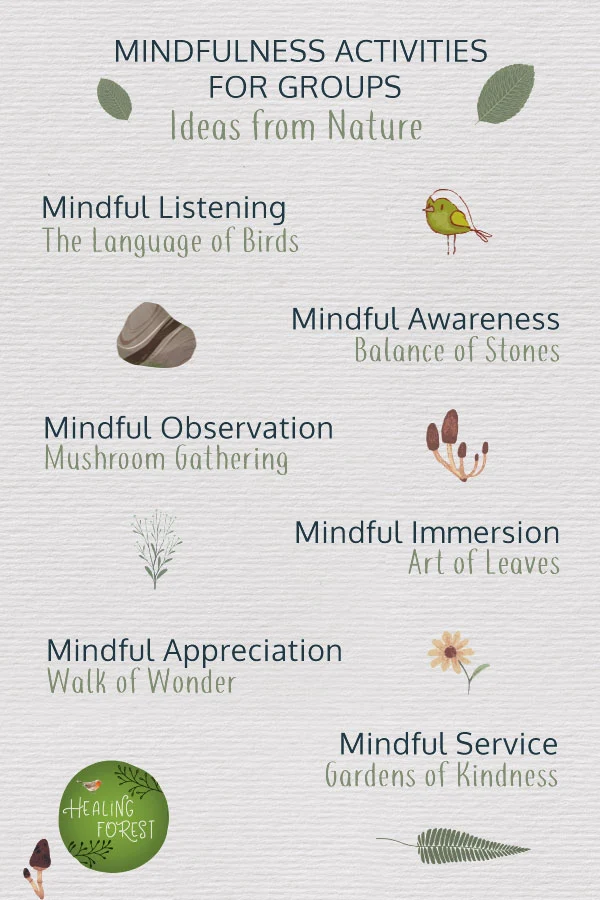
7 Outdoor Mindfulness Activities for Groups

All the mindfulness group activities integrate elements of nature, which makes it easy for beginners to access the concept of mindfulness. The groups not only achieve the benefits of mindfulness, but also the multiple health benefits of being outdoors.

mindfulness activities

“The essence of nature mindfulness is to dissolve boundaries –
between inner nature and outer nature,
between you, me, us, and them.”

These mindful activities and exercises can be done solo or with friends and family. With nature and mindfulness you can overcome many challenges that one faces while holding group activities. The more diverse your group is, the more insightful its results. Try these outdoor mindfulness activities for adults and kids and make mindfulness easy, engaging, and fun for all ages.

Mindfulness Activity: Language of the Birds

What is the difference between regular bird-watching and mindful birding? While our eyes make up the primary sense for the former, the most important sense for mindful birding is our ears. Rather than counting the number of different birds that we can see, our focus is on learning how to create calm with the help of the birds.

Mindful Listening

We recommend keeping all cameras and phones away. Once you find a space that has sufficient bird activity, ask the group members to find a spot for themselves and sit in silence.

Listen to the closest bird.
Listen to the farthest bird.
Listen to the birds in different directions.
Listen to the silence in between the birdcalls.
Listen for conversations. Follow the sound of a particular species and imagine what the birds are trying to say?

The group can share their stories, insights and learning at the end of the session.

Spending time with the birds in a mindful way leads to some beautiful insights. Here one such story from a flock of swifts by Helen Macdonald, Author H is for Hawk.

“Swifts have, of late, become my fable of community, teaching us about how to make right decisions in the face of oncoming bad weather. They aren’t always cresting the atmospheric boundary layer at dizzying heights; most of the time they are living below it in thick and complicated air. That’s where they feed and mate and bathe and drink and are. But to find out about the important things that will affect their lives, they must go higher to survey the wider scene, and there communicate with others about the larger forces impinging on their realm.”

Just like the birds, sometimes we have to let our minds soar above our day to day worries and see our lives from a higher perspective. Mindfulness allows us to do that, helping us discover wiser choices for our future.

Nature Mindfulness

Mindfulness Activity: Inner Balance

Mindfulness creates a balance of attention and awareness. The real goal of mindfulness is not just paying attention to the mind, but creating an awareness of its true nature.

Balance exercises have found to be very helpful in relieving stress and reducing inner tension. Additionally, they improve focus, concentration and memory. Finally, the unquestionable benefit of the mindfulness activity is the ability to control emotions in critical and stressful moments. The simple act of balancing stones is a very powerful mindfulness technique.

Mindful Awareness

The activity starts by collecting suitable stones and in the first round participants work on their own to see how high can they make their stone towers.

In the next round the same activity is done in pairs, but in silence, without any exchange of words. Once all the pairs have created their stone towers, we dismantle all the stone towers for the final round.

The final round, also done in pairs involves creating an inverted pyramid of stones – with the smaller stones at the base, and larger stones on the top.

Instead of just focusing on stacking the stones, pay attention to the center of gravity of each stone. With patience one can find out the exact alignment between two stones, which leads to the equilibrium of balance. At the end of this exercise, the group can sit in a circle and spend a little time to contemplate things that bring balance to their lives.

Fun Mindfulness Activities For Groups

There is a common myth that mindfulness has to be a very serious practice. However mindfulness in nature teaches us something very useful. To turn any activity into a habit, you have first learn how to have fun with it. If you don’t enjoy the process, it is difficult to sustain.

The mindless entertainment we engage in through television or social media may keep our attention focused, but it does not provide rest to our mind. On the contrary it over-stimulates it. One can see its impact in depleted attention spans, reduced concentration, and poor memory.

Here is a collection of 3 outdoor mindfulness activities that make use of the leaves for mindful immersion. These activities help you create some unique artworks, especially in Autumn.

Creative Mindfulness

Leaf Tracing: Pick any leaf. You choose a simple one or a complex shape. Trace the outline of the leaf with your eyes as slow as you can. Move from one edge of the base, all the way around to the complete the loop. This exercise is an excellent way to slow down your thoughts.

Leaf Collage: Group members work in pairs. Using different leaves they have to create a mythical or magical forest creature. Use the imagination to escape into a hidden world. This simple exercise raises the energy levels of the group. So the group leader must ensure that the silence of the group does not get lost.

Leaf Mandala: Each person in the group is assigned to collects leaves of a particular colour or shape. The group then works as one unit to create a geometric design on the forest floor using all the different leaves they have collected. It could be concentric circles, spirals, or a four-sided maze.
*TIP: Zoom Mindfulness Activities: As an interesting experiment, share these activities with friends who may be in different cities. Ask them to do any of these nature mindfulness activities at their own convenience. Schedule a Zoom session / call later to exchange insights. It creates a beautiful experience of learning and growing with each other. 

Mindfulness Activity

Mindfulness Activity: Mushroom Lessons

While observing the breath is a very common mindfulness exercise, people who are going through a difficult phase in life find it very challenging because of troubling thoughts. Therefore, we should start with other senses first, especially when introducing mindfulness to beginners. Our visual sense can be a powerful ally. Turning to nature to observe and discover its many treasures shall fill us with awe, wonder, and deep calm.

Mindful Observation

When you enter the woods to search for mushrooms you have to be alert, silent, and calm.  By being mindful of your steps as you walk in the forest gently, you can turn this rewarding activity into an exercise in mindfulness.

NOTE: Be sure to buy a good field guide for mushrooms from your area or go with an expert. Some basic instructions for Mushroom Walks, as per the Modern Forager are given below.

1. Tread Lightly. Don’t trample all the little mushrooms and potential mushrooms in your hunting ground.
2. Make a positive identification using more than one source wherever possible. “When in doubt, just leave the mushroom.”
3. Mature mushrooms release spores into the air that are essentially mushroom seeds. You can respect the spores by leaving some of the mushrooms untouched.
4. Don’t use plastic bags — which can ruin your harvest anyways; look for mesh bags, baskets, buckets with holes drilled in them.
5.  Micro-trash is a big problem! Try to leave none and collect some if you see any.

Mindfulness Activity: Power of Awe

One of the most effective nature mindfulness activities for adults involves focusing on the emotion of awe, and wonder. It helps to shift our attention from the negative cycles of our mind that pull us down, to a more positive frame of mind.

For this mindfulness group activity we can either use the treasure-hunt model where the group goes out into nature and collects object based on a pre-given list, or we can ask the group members to just take a photograph of the objects.

For larger groups it is better to use photographs as it creates a lesser impact on the surrounding. The simple rule all participants need to follow is that you can only take one photograph per activity on the list. By restricting the number of photographs, we get the group members to be more mindful of each shot they take. With this single rule we can turn our device of distraction into a mode of meditation.

Mindful Appreciation

One thing that makes you smile.
One thing that brings you calm.
One that fills you with hope.
One thing that makes you curious.
One thing that fills you with awe.
One thing that you are thankful for in nature.

What happens when we experience wonder? By Katie Steedly
People get along. When people are struck with wonder, they generally are not yelling, arguing, fighting, or angry. Wonder brings people together. We all agree that flowers are wonderful. We all agree that ducklings are wonderful. We all agree that coral reefs are wonderful. Butterflies? Wonderful. Chocolate? Wonderful. Sunsets? Wonderful. Wonder provides a moment where we can hold hands, (perhaps) tear up, and find common ground. The noise of life fades. A silence akin to speechlessness falls when we experience wonder. A gentle hush that is beyond words eases tension. Reflection paints wonderful moments with reverence. Wonder is calm in the chaos of the world. 

Nature Mindfulness

The ability of Nature to inspire awe and wonder are one of the big factors that contribute to its healing effects on our mind. After a mindfulness in nature session, brain scans showed a sizeable reduction of blood flow to the subgenual prefrontal cortex region. It is a region linked to sadness, withdrawal and general grumpiness.

Mindfulness Activity: Growing Kindness

Community service as an outdoor mindfulness activity is an essential way of channelizing group energies for creating positive transformations. One such exercise involves creating or working in community gardens.

Mindful Service

FOOD GARDEN: South Central Los Angeles, USA is a food desert – an area filled with liquor stores, fast food chains and vacant lots. Tired of driving 45 minutes to buy food that is not chemically treated, Ron Finley decided to turn some of those unused plots, starting with the patch in front of his house, into a food forest. With obesity rates 5X higher in South Central than in Beverly Hills, a neighbourhood only 8 to 10 miles away, Finley realized that food is the problem, but is also the solution. “The drive-throughs are killing more people than drive-bys”, he says. Finley and a group of volunteer gardeners from all over Los Angeles are changing that, one lot at a time. “Growing your own food is like printing your own money.”

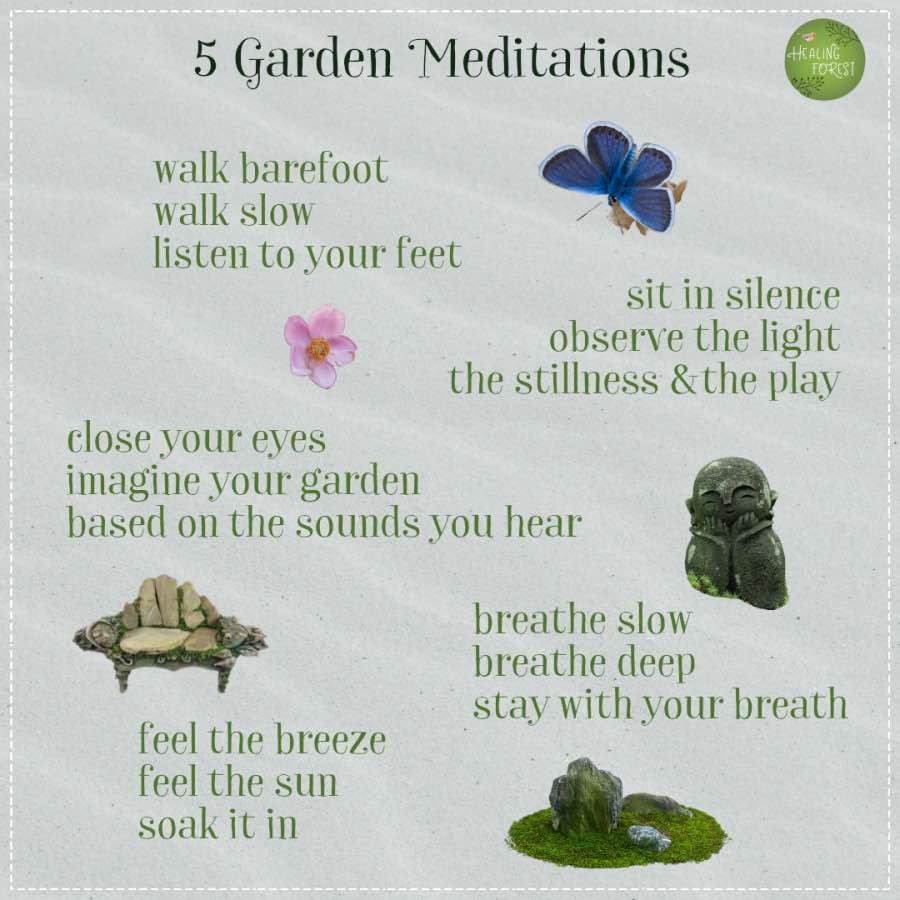
MEDITATION GARDEN: A meditation garden is an island of tranquility which allows you to connect with nature and with yourself. It offers you a space to plant seeds of peace, hope, wonder, and joy within you. With a few simple nature elements you can transform any garden into a meditation garden. The heart of a meditation garden, beyond its visual appeal and the calming aesthetics is the thought, practice, and care which goes into connecting with your garden.

Mindful Activities

Mindfulness in Nature

The real measure of our progress in mindfulness reflects in our behaviour and actions. The awareness of mindful groups is not limited to the present moment, but extends to foresee the impact of their actions on the future. Given below is our collection of activities that will inspire you to to create countless mindfulness in nature experiences.

This collection of outdoor mindfulness activities is just a small selection from our treasure trove. To get useful new ideas once a month, join our free newsletter.

Best Mindfulness Activities for Adults & Kids

Go on a remarkable journey to cultivate a peaceful mind, a healthy body, and beautiful relationships. Given below is our collection of best mindfulness activities for adults and families. Also included are many secret forest gifts.

Healing Forest

For Adults: Collect 150+ of our best nature mindfulness activities that transform your mind, body, relationships: Nature Calm >

For Parents & Kids: Learn life’s most useful skills with 10 amazing walks. Check out: Nature Play >

Every breath we take is a gift from nature. By being mindful of this simple truth we can learn a beautiful life-lesson. Watch this 2 minute meditation to practise the mindfulness activity hidden in every breath.

All life exists as a relationship. Through mindfulness in nature we learn to explore our relationships with self, others and our world. Seeing a part of our Self in everything, and a part of everything in our Self, is an invaluable experience of these nature mindfulness activities.

Healing Forest is a project that aims to bring people and forests closer to each other through creativity and mindfulness. Our goal is simple. Helping people heal. Helping forest heal.

REQUEST: Please share this post so it reaches those who really need it.

Let the rivers of the world show you how to be resilient in life. Dive in, as we share inspiring examples and stories of resilience from the rivers.

Resilience is the ability to withstand adversity and bounce back from difficult life events. Being resilient does not mean that people don’t experience stress, emotional upheaval, and suffering. Rather it is an inner trait which helps them adapt to the changing situation and keep moving forward.

Floating down the river of time, each one of us will meet our own set of obstacles, hurdles and difficulties. How we overcome them or deal with them is based on our resilience. Here’s a list of some interesting ideas for navigating through the challenges that life may brings us.

SHORTCUTS:
6 Stories and examples of resilience from Central America | Tibet | Peru | Egypt | U.S.-Mexico | Resilience Film

6. Resilience Example: A Story from the Past

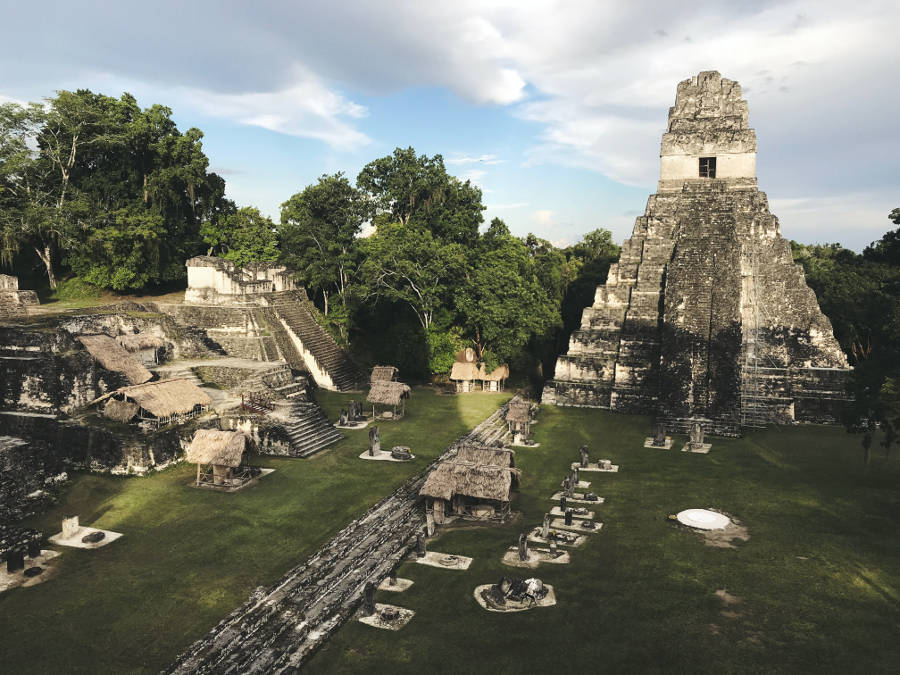
The ancient, abandoned Mayan city of Tikal is a famous site in Central America. Its huge structures – some of which are over 70 meters high – show that the Mayans must have been supremely powerful and wealthy. But despite this wealth and dominance, Mayan civilization collapsed and its cities were left to crumble. Its downfall was self-inflicted.

Resilience Example
pic by: Jimmy Baum

As the city of Tikal grew more wealthy, its population started to grow quickly. Faced with more mouths to feed, the Mayan leaders reacted by clearing the surrounding forests to create farmland for crops. While this might have brought more food in the short term, in the long run it brought huge environmental pressures. The damage was twofold. Firstly, the erosion left the fields less fertile as the nutrients in the soil were washed away. Secondly, soil was washed into nearby rivers, clogging up irrigation systems. This led to a drought that withered crops.

The rivers are the lifeblood of civilisations, but in the race for power, fame, glory, we often forget to take care of important things. Instead of finding ways to grow more food sustainably, the Mayan leaders spent time and resources on building ever more expensive monuments to themselves and on waging war with rivals. The wars and the wasting of energy helped to quicken the decline begun by the damage to the environment. Together these factors brought a once powerful society to its knees.

INSIGHT: When faced with a crisis, we have to focus on the essential. By safeguarding the things which nourish us, feed us and help us grow, we can get through hard times. What are the things that constitute the rivers in your life? What are the things you must protect and preserve at all costs?

Source of Story: Collapse by Jared Diamond.

HOW TO BE RESILIENT?

Resilience is how you recharge not how you endure. We normally believe that resilience depends on strength. This is only half true. It is the lack of recovery period which depletes our resilience. Not being able to rest weakens the mind, and erodes our health. Overwork, overstimulation, poor sleep affects us deeply. Losing our resilience leads to burnout and worse.
So what’s the key to resilience?

Trying hard. Recharging. Trying again.
A river will stop flowing if it is not recharged.
It’s the same for humans.

Learning to be resilient requires wisdom and courage, foresight and willpower. The river insights in this article are a way to travel into your mind. We cover many stories and examples that will take you on a journey within. An enquiry, which leads you to discover your own path to resilience. Finding answers to the questions at the end of each section will create a map of resilience for your life. *The short resilience film at the end of this post, is a gift from the rivers. An uplifting message from a beautiful mountain stream.

“Be like water making its way through cracks. Do not be assertive, but adjust to the object, and you shall find a way around or through it. If nothing within you stays rigid, outward things will disclose themselves.”

~ Bruce Lee

5. Resilience Example: A Story from Nature

Resilience Story

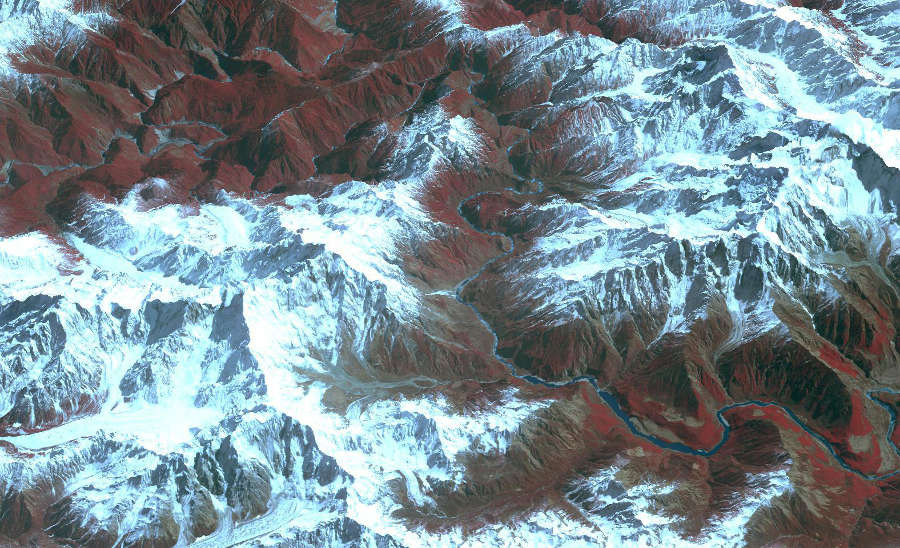
The Yarlung Tsangpo river is known as the roof of the world and is the highest river in the world. The river is often called as the “Everest of Rivers” because of its extreme conditions and lofty elevation. The average elevation being about 4000 meters, Yarlung Tsangpo starts from the Angsi Glacier in Tibet and runs across Tibet, India and then meets The Bay of Bengal. It has to navigate its way through multiple mountain ranges. While leaving the Tibetan Plateau, the river forms the world’s largest and deepest canyon, Yarlung Tsangpo Grand Canyon which is much longer than the Grand Canyon. The Yarlung Tsangpo is certainly one among the most unusual and inspiring rivers of the world.

INSIGHT: The river is stronger than the mountain. The way of the river, ever searching, ever flowing, always finds its path around the obstacle. In the flow of the river one can observe its true strength. Drawn by its pull to the sea, aided by gravity, every river seeks out its path and sometimes even creates it. These canyons are beautiful pieces of geographical art which serve as a reminder, that in nature, water cuts rock. What constitutes your strength in life? What are the values that you can rely on, to keep you flowing?

The same thinking can also be applied for building resilience to overcome negative habits. To change a habit, substitute the behaviour with a positive habit which creates a similar reward. That’s why the golden rule for quitting any habit is this: don’t try to resist the craving; redirect it.

4. Resilience Example: A Story of Change

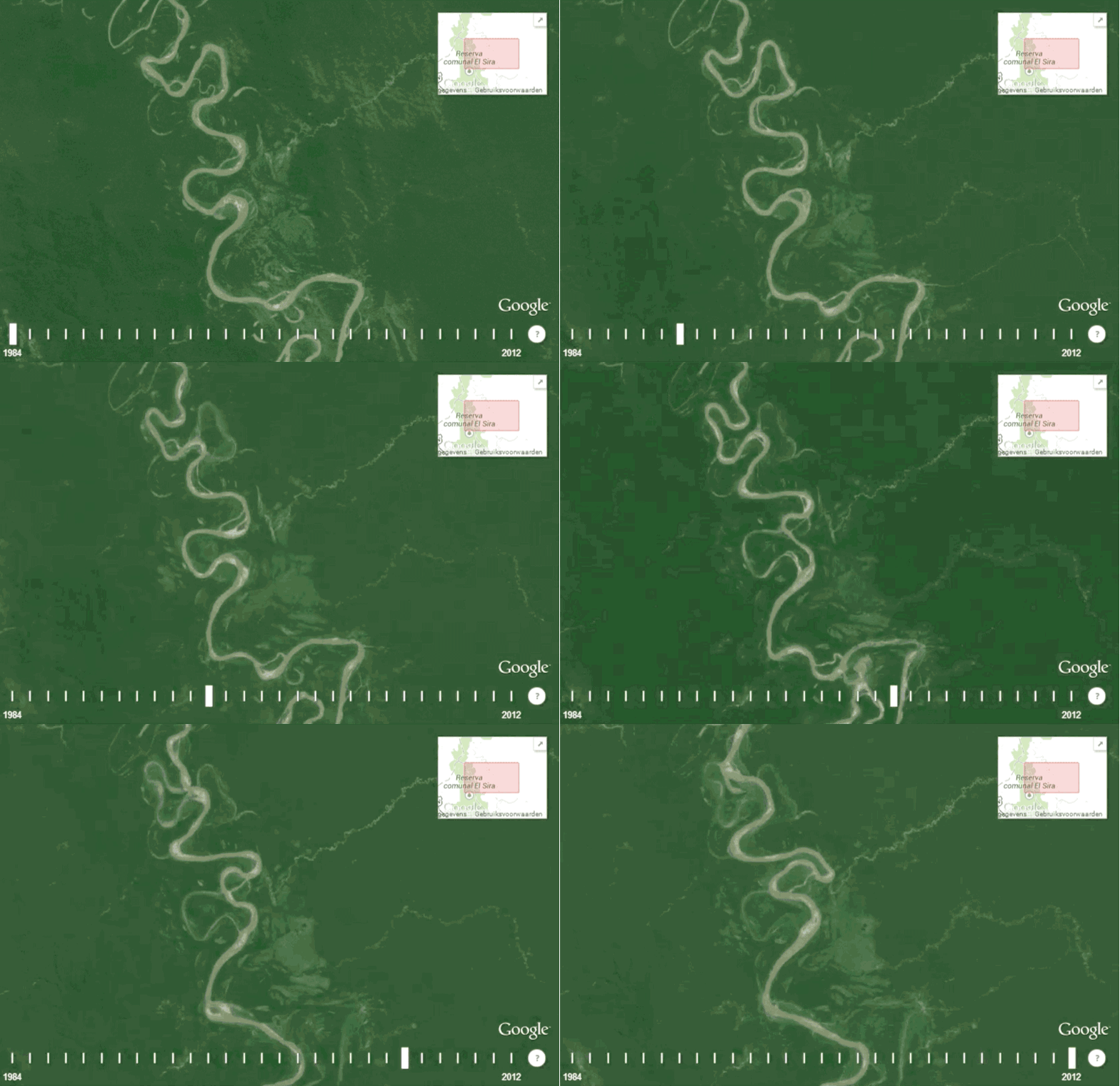
The spirit of the river is the spirit of an explorer. When you stand next to a river, its path doesn’t seem to move. But this series of satellite images of Peru’s Ucayali River — featured in Google Timelapse project — reveals something pretty remarkable.

Over the course of fewer than 20 years, its path crawls back and forth, carving out deeper and deeper curves before cutting them off and starting over. All rivers naturally change their path over time, but this one forms meanders (the technical name for these curves) at an especially fast rate, due to the speed of the water, the amount of sediment in it, and the surrounding landscape.

INSIGHT: The key insight here is that, to build our resilience we need to work on our ability to explore. Exploration enables you to grow as a person. It challenges us to overcome our fears and anxieties. It’s how we learn more about the world. The second part is internal. It comes down to creating an understanding of the world through abstract thought. It’s the desire to learn new information and discover new ideas. People who seek out unfamiliar information and experiences, also tend to be intuitive, empathetic, and richer in their emotions. What are your sources of inspiration and motivation? Who can you turn to for advice and new insights?

Resilience is our capacity to change. It’s a positive state that is resourceful, adaptable and energised. Unlike bouncing back and coping, states that can be quite draining over the long term, or grit, that can be rigid and isolating, resilience is a place of high creativity and flexibility.

~Anise Bullimore, Resilience Coach

3. Resilience Example: A Story of Floods

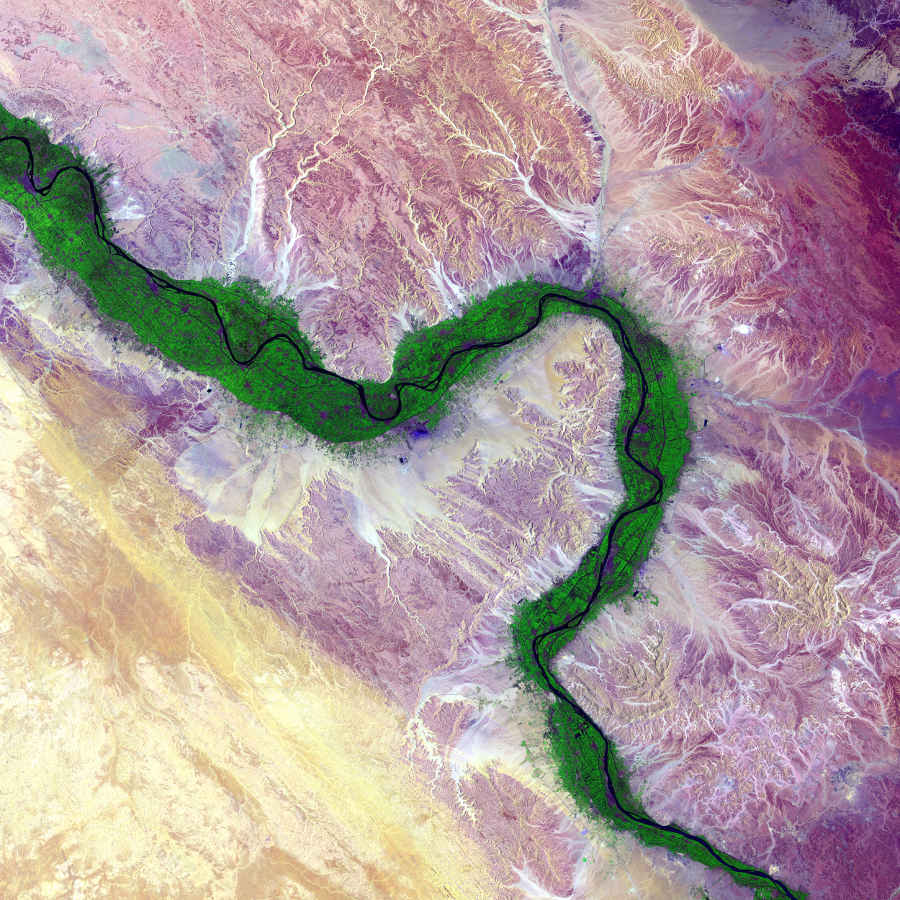
The River Nile is about 6,670 km (4,160 miles) in length and is the longest river in the world. The Nile receives its name from the Greek Neilos, which means a valley or river valley. In Egypt, the River Nile creates a fertile green valley across a barren harsh desert. It was this gift of the river that allowed one of the oldest civilizations in the world to flourish. The ancient Egyptians lived and farmed along the Nile, using the soil to produce food for themselves and their animals. 

Resilience example 2

Regular as sun and moon, in the middle of burning summer, without a drop of rain in sight, when all other rivers on earth were drying up, for no apparent reason at all, the Nile rose out of its bed every year, and for three months embraced all of Egypt in a flood. The people’s happiness or misery depended upon the annual flood. (Uncover the source of this mystery here.)

Generally floods are seen as a form of natural disaster creating loss and damage. But in the life cycle of a river they play an important role. Flood waters carry nutrient-rich sediments which restore the fertility of the land. Floodplains are beneficial for wildlife by creating a variety of habitats for fish and other animals. In addition, floodplains are important because of storage and conveyance, protection of water quality, and recharge of groundwater.

MEDITATION: In life, there are some floods that one cannot avoid. However being well prepared for it and knowing how to manage the flood can help us strengthen our resilience. What are the floods that you can be prepared for? What gifts are you meant to receive from them? What is their role in your personal growth.

*To go on a deeper journey into the mind, check out our fascinating Forest Meditation collection.

2. Resilience Example: A Story of Rebirth

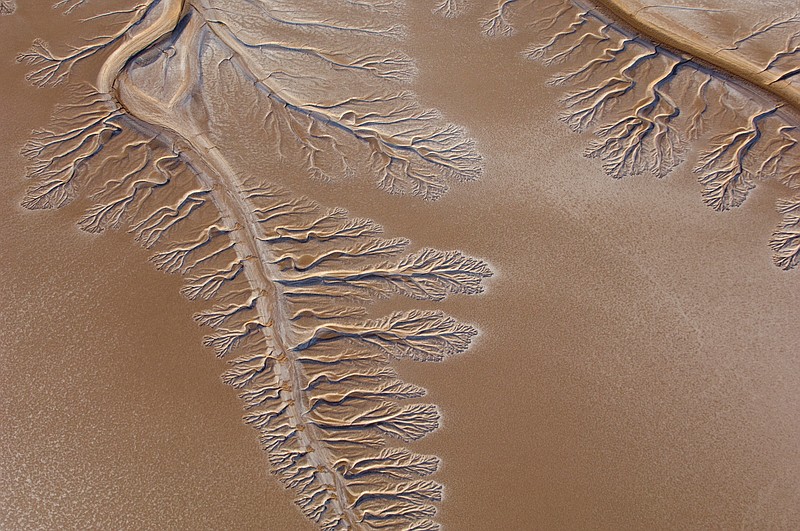
Colorado Delta, was once one of the most biologically diverse desert aquatic ecosystems on the planet. Paddling the delta in 1922, naturalist Aldo Leopold was entranced by the flourishing world beyond the tip of his canoe. “Verdant walls of mesquite and willow . . . a hundred green lagoons,” he wrote. “The river was everywhere and nowhere.”

Resilience Story 2
Pic by: Pete McBride, U.S. Geological survey

But things have changed since then. By the time the Colorado reaches Mexico, nearly 90 percent of its water has been siphoned off for farms and cities. For the most part, the delta has been reduced to a desiccated wasteland, dominated by invasive tamarisk trees and discarded trash. 

In the spring of 2014 an experimental pulse of water was released into the Colorado Delta. It was an experiment to see what would happen and whether it was possible to  regenerate habitat. What people witnessed was something extraordinary. 

Within a couple days of being wetted by the pulse flow, billions of tiny copepods had hatched. Some were now feeding on algae along the river’s fringe. Dragonflies eat copepods, and they flew into hunt. Carp coming down the river were feeding on the dragonflies and fish larvae were also eating the copepods. The water’s life-giving effects spilled beyond the river’s banks. Kids who’d never seen it in its natural channel splashed and played. Spontaneous festivals came to life. Birds returned, and trees and marshes greened up.

MEDITATION: Nature has an inbuilt resilience. Things which appear to be dead are merely dormant and spring back to life once the conditions are right. It gives us hope that in the river of time, no matter how difficult the circumstances, we just have to wait for the water of life to come back and restore our fragile but precious sense of aliveness. How can you build your patience and reserves of energy? How can you connect with nature to understand its laws better?

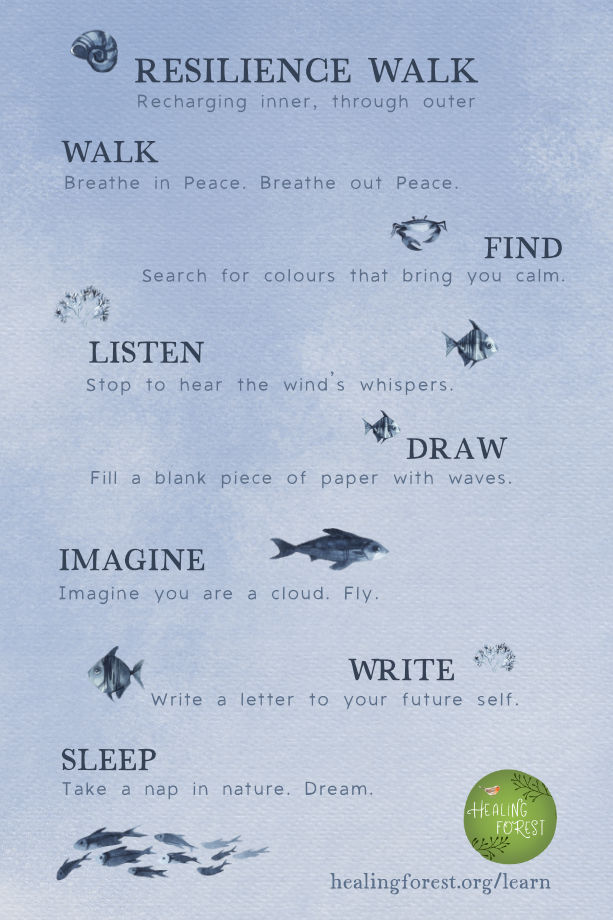
Resilience Walk

In these challenging times, it has become essential for all of us to guard our mental health. Try this engaging walk in nature to explore simple ways of building your mind’s resilience. Calming activities that recharge your inner world, through the outer.

Download High Res Poster

1. Resilience Example: A River Story

Film Credits: Film- Nitin Das | Music- Chris Haugen |Additional Footage- GreenHub | Production- Colorcaravan | Research: HBR Blog | *Please view in fullscreen mode with sound.

The river is not just a body of water flowing into the sea. It is a complex ecosystem. A set of relationship between the water and the many beings whose lives are linked with its flow. A variety of plants, animals, insects, microorganisms, and the river form a web of life which supports and nourishes each other’s life cycle. The influence of the river’s water extends far beyond its observed edges.

INSIGHT: It is difficult to say where the river begins and where its boundary ends. Similarly, our resilience is codependent on the resilience of other people in our lives. It is also dependent on the resilience of the environment we live in. Who can you turn to, for support in tough times? What are the places that you can go to recharge yourself? And more importantly, who can you support when they are going through a tough time?

Resilience is a quality that can be learnt and strengthened. By finding spaces that rejuvenate us, and sharing it with others in their time of need, we are building our own resilience and also creating a resilient support network.

Rivers are stronger than mountains

In case you enjoyed this post, do try our Nature Calm course and find new ways to grow your resilience.

Uplifting Activities To Help You Grow:
Nature Calm

The twists and turns of life affect us in many ways. Therefore, learning to take control of our own wellbeing is an important skill. Let’s discover how to find peace, purpose and resilience with the help of nature. We share the best ideas and practices from around the world. To get useful new ideas in your inbox, you can join our monthly newsletter.

Which is your favourite river? And what has it taught you? Do add your thoughts in the comments below so that we can grow our collective knowledge. Please share this post with friends, so that it reaches where it’s needed.