A still mind, reflects the universe. Let us introduce you to the beautiful idea of a reflections walk. A walk that reconnects you to a few important moments from the past. These reflections will help you unwind the year that was and prepare you for the year that will be.

You can do the reflections walk alone or with people who are close to you. All you need is a pen and a notebook to collect your thoughts. Find a peaceful nature space near you and go for a gentle walk. Follow the principles of the Japanese concept of mindful nature walks, also known as ‘Forest Bathing‘. The aim is to be silent, go slow. Open your senses to absorb the calm of nature, and carry it within you.

“Remember that when you leave this earth, you can take with you nothing that have you received–only what you have given.”

~ Francis of Assisi

Reflections Walk

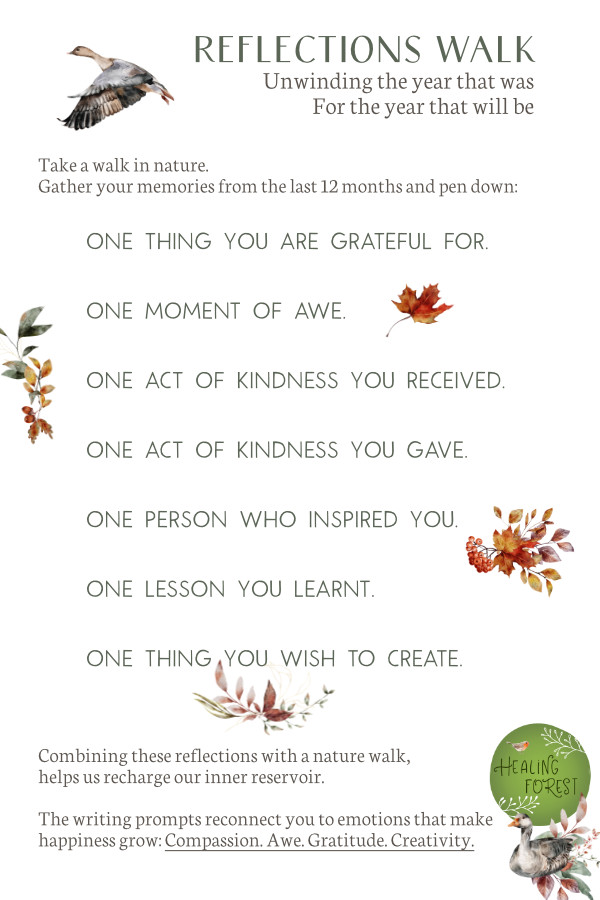
The reflections walk consists of 7 writing prompts. The prompts have been carefully chosen to light up parts of your mind that trigger positivity. These memories and insights foster the core emotions that make happiness grow: Compassion. Awe. Gratitude. Creativity.

Give yourself 10 minutes for each writing activity and in case you have others with you, follow it up with a sharing circle. For larger groups, it is recommended you break up into smaller groups of 3~5 for sharing. After each sharing session do a short 10 minute walk in nature. Combining reflections with a nature walk, helps us recharge our inner reservoir. It also helps in assimilating the learning and deepens your experience.

Here are the writing prompts for the reflections walk. Gather your memories from the last 12 months and pen down:

One thing you are grateful for.

One moment of awe

One act of kindness you received.

One act of kindness you gave.

One person who inspired you.

One lesson you learnt.

One thing you wish to create.

TIP: Doing the reflection walk on your own is wonderful, but sharing it with others is amazing. Creating a shared experience not only grows our collective learning, but also forms a special bond based on a deeper understanding of each other. An interesting idea is to email this post to friends who may be in different cities and schedule a WhatsApp / Zoom session to share insights from their reflection walk.

Download link of poster given at the end.

“The great secret of morals is love, and a going out of our own nature and an identification of the beautiful that exists in thought, action, or person not our own.” 

~ Percy Shelly

Dacher Keltner, renowned psychologist and founder of the Greater Good Science Center at UC Berkley says, “The emotions of compassion and gratitude and awe, I think they really tell us that human nervous system isn’t just fight or flight. Sigmund Freud gave us a great legacy: the two great instincts of sex and death. We would say there’s a little bit more than that, right? Then, they also tell us that a lot of the great delights in life come from serving others, that the human mind is wired up to do so. When you express compassion, you’re getting this big rush of vagus nerve activation and oxytocin. This feels great. When you show gratitude to somebody or sharing, similar studies show you get activation in rewards circuits in the brain. We’ll find that happens with awe as well. Human beings are wired to care and give and it’s probably our best route to happiness.

12 Beautiful Lakes to Reflect upon

Lakes serve as a metaphor for the complexities of our mind. As the year draws to a close, here’s a short film to reflect upon some beautiful lakes from different corners of our planet.

Our monthly posts help you discover not just uplifting activities but also amazing nature spaces from around the world. To get useful new ideas once a month join our free newsletter.

A Gift For The New Year

We hope your new year is filled with calm, clarity and good health. Here’s a collection of 12 Forest Wallpapers + reflections walk poster to inspire you to go out for more nature walks. And when you do, don’t forget to share the treasures you find with others.

Healing Forest is a volunteer driven project. Our goal is to bring people and forests closer to each other through creativity and mindfulness. The aim is simple. Helping people heal. Helping forests heal.
The decisions we make, design our life. But seldom are we taught the invaluable skill of designing our life, often stumbling from one decision to another. 

Those who learn to observe nature, notice a beautiful balance that exists in all the designs. A harmony that has been crafted to perfection over an ocean of time. But Nature is never at rest. Just like our mind. Constantly changing. Constantly evolving.

Imagine, if we could learn the principles of design from nature. Would it change the way we make decisions for our life? Let’s try an interesting experiment in nature.  We will create some unique nature art and introduce you to the rules that guide nature’s design. Also, through short reflective walks based on the Japanese concept of Shinrin Yoku, we understand how the same rules apply to our own life.

We hope this experience lends you new insights for your decision making skills, and helps you design a life in which your inner and outer world are in tune with each other.

Nature’s Design Tips For Your Life

Design is nature’s way of problem solving. In this article we offer you some thought-provoking design challenges to grasp the art of nature’s design through hands-on activity. Each activity is followed by a short walk to deepen your experience as well as your learning.

These walks are based on the Japanese concept of mindful nature walks also known as Forest Bathing. If you haven’t already, do check out this short guide before you begin: What is forest bathing?

The aim of a mindful nature walk is to use our senses to quieten the mind. In the stillness, we gain new insights about human nature by growing our awareness of the nature outside. All activities are done in silence. Each activity is followed by a slow walk, focusing on one of our senses. The senses act as a bridge between the inner and outer.

This activity is part of our 12 uplifting walks that help us learn life’s most useful skills through nature.

Nature’s Design Tip #5: Impermanence

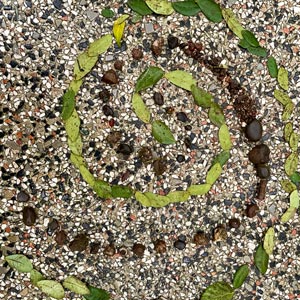
Designing 2 Spirals: For the first activity, the group is divided into pairs. Ask each participant to create a spiral from objects found in nature.  So each pair needs to create 2 interlocked spirals. Interlocked spirals enclose each other, but don’t touch each other at any point.

The spiral is a metaphor for the trajectory of our lives. As humans, we try to move in an ever expanding path of growth. However, when life ends, the spiral terminates abruptly. When we observe nature’s design, we see that things serve a purpose even in the after-life. So it starts from nothing and fades back into nothing.

Impermanence can brings a new perspective to our decisions. The ability to make a good decision is also the ability to foresee its impact in the future. Consider the 10/10/10 rule. What will be the impact of your decision 10 minutes from now, 10 months later, and after 10 years. What decisions can we take for our life’s work to have meaning, even after we are no more?

Walk: Take a 10 minute silent walk and reflect on the impermanence in nature’s design. You can walk by focusing on the sounds of nature. Start by focusing on the louder sounds, and gradually mover your attention to the more softer sounds. Every sound is a song of impermanence.

Nature’s Design Tip #4: Interconnectedness

Ant Bridge: Design a bridge for ants to cross. Find any large gap in your surroundings and build a connection so that it can serve as a bridge for ants and other tiny creatures. Only use material that can be found around you, without breaking or damaging the nearby plants. This activity is also meant to be carried out in pairs or small groups. Give bonus points for the longest bridge, and for the strongest bridge.

Bridges are metaphors for interconnectedness. Creating connection helps us get from where we are, to where we want to go. There are many times in life where we get stuck at some problem. Quite often the solution is to connect with someone who can get us out of our predicament. Bridges serve as links of exchange between us and others. Learning their importance uplifts our lives.

The design of nature is filled with invisible interconnections. For example, the roots of trees in a forest are connected to each other and communicate with each other through a network of fungi. It is this interconnectedness that allows many species to co-exist and thrive.

Walk: For this segment of the silent walk,  bring your attention to your feet and the ground beneath it. With each step become aware of how deeply we are connected to the earth.

Nature’s Design Tip #3: Interdependence

Pyramid / Inverted Pyramid: Design a pyramid made up of sticks or rocks. To make it more challenging ask the participants to design an inverted pyramid, where the base is smaller than the section on top. The task might appear a bit daunting, but the secret of designing an inverted pyramid is to create proper support. Those who can figure out the trick of supporting the heavier section will be able to overcome the difficulty of imbalance.

With new insights emerging in our theory of evolution, “survival of the fittest” theory has been transformed into “survival of the kindest.” Darwin himself wrote, “Those communities which included the greatest number of the most sympathetic members would flourish best and rear the greatest number of offspring.” What Darwin called “sympathy,”  can be termed as empathy, altruism, or compassion. According to biologists from Darwin to E. O. Wilson, compassion is the reason for both the human race’s survival and its ability to continue to thrive as a species.

Walk: Walk with your attention on the breath. Every breath we take, has come from a tree. Every breath we give, will go back to the forest. The design of nature is a delicate balance, in which how we are all interdependent.

Nature’s Design Tip #2: Individuality

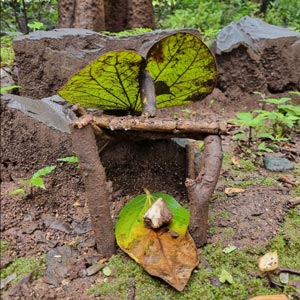
Forest House: This is a solo activity. Every participant is asked to design a tiny house for a creature of the forest. The creature could either be an animal or bird that is commonly found in the area or for a magical being like an elf or a gnome. The design of the house should reflect the needs of its occupant. The designers can even give a name to their house.

Once the houses are complete, all participants can do a quick tour of the colony of tiny homes that have sprung up. The makers explain their thought process and the most important aspect for them while designing the house.

The learning from this activity is to appreciate the uniqueness of each design. To observe how for every person, certain values hold greater importance over others. The designs they create and the decisions they make stem from these values. Nature has gifted each one of us with a unique mind. Exploring our inner world to uncover that uniqueness, can lead us to make better choices for the direction of our lives.

Walk: This segment of the walk focuses on our visual sense. Pay attention to what you see around you. Observe the uniqueness within each and every entity in nature. Becoming aware of this grand scale of nature’s design fills us with respect and humility. It makes us appreciate the individuality within others as well as within ourselves.

Nature’s Design Tip #1: Inclusivity

Forest Creature / Forest Village: This is a group activity. Divide the participants into small groups of 5 or less people. Each participant collects 10 fallen leaves and brings it to their group. The aim of each team is to design a small forest creature or a forest village using leaves to represent buildings / body parts. The teams are free to include surrounding stones or trees  as elements in their design.  Within the team, members can only speak in 1 word conversations – to elaborate what the items represent: for e.g: a school, a hospital, a park etc.

Including others in the design and decision making process can be very challenging. Especially if they have divergent views and personalities. However, nature teaches us that greater diversity yields richer benefits. In nature, biodiversity is critical for survival as it enhances the ability to face challenges and natural calamities. Similarly, bringing different ideas together allows us to create something where the whole is greater than the sum of its parts.

Walk: We close the Natures design walk, through a group sharing activity. All the participants form a circle, facing outwards – towards nature.

Sit in silence for 5-10 minutes. Observe how we are all part of nature, and how the same rules that are found in nature’s design apply to our own minds, bodies, and lives.  Let the boundaries between our inner nature and the nature outside slowly dissolve. Experience a sense of oneness.

To end the Nature’s design walk, participants can share any insights or learning from the different activities. Sharing transforms individual learning into a collective experience. On the same lines, do leave your thoughts in the comments to share any insights or observations.

The Larger Design

Some of the greatest challenges we face today are a result of designs that dictate our society’s growth. The world’s 7.6 billion people represent just 0.01% of all living things by weight, but humanity has caused the loss of 83% of all wild mammals and half of all plants.

The multiple crises we face today are so overwhelming that they can create a certain degree of resignation and despondency. But as humans we have a capacity to redesign our way of thinking. Reconnecting with nature will bring us old wisdom and new ideas for solving our current problems. Above all, it will link like-minded friends, so that we can create a mindset shift on a much larger scale.

Let’s reimagine a new design for our planet… one walk at a time.

Life’s Most Useful Skills
>>Nature Play


REQUEST: Please share this article, so it reaches where it’s needed. To get useful new ideas and inspiration, you can join our monthly newsletter  For more activities and many other experiences, try our Nature Calm course.

Healing Forest is a volunteer driven project that aims to bring people and forests closer to each other through creativity and mindfulness. Our aim is simple. Helping people heal. Helping forests heal.

How do you create joy out of nothing? Take a Joy Walk in nature to unlock the happiness hidden within your body. Joy Walk is a unique experience filled with fun activities that show you how to tap nature and movement to make the invisible, visible.

Our modern lifestyles often fix our body posture into set routines. You follow a daily and weekly schedule with a limited range of activities. As a result, a lot of our actions and emotions become restricted and brittle. The negative effects reveal themselves over time.

The Joy walk releases trapped emotions and hidden stress within the body. Through the creative ideas, you bring fluidity and flexibility not just to your body, but also to your mind.

Joy Walk Guidelines

Here are the simple principles of Joy walk, captured in 3 lines.

When you move, create harmony

When you are still, create awareness

Being in rhythm with nature, create joy

Do not force you body to perform. Let the movements happen naturally. Create a flow and go with it. There is no need to carry any props or music for the walk. The sounds and gifts of nature are enough.

Joy Walk Activities

Typically the duration of the Joy Walk ranges from 60~120 minutes. Take a slow walk through nature and pause at regular intervals to carry out the different activities mentioned below. The design of Joy Walk moves from group engagements to pairs and ends with solo time in nature. Feel free to experiment, modify, and adapt.

Leaf Dance
The group forms a circle and raise their hands up in the air. Pretend the hands are leaves on a tree. A gentle breeze blows, creating a wave that moves along the circle. Slowly the wind starts picking up speed swaying the leaves with increasing gust. And then a storm comes and blows all the leaves away. The leaves dance away in the wind and finally come to rest on the ground.

Who am I dance
Each person introduces themselves as an object from nature. Instead of stating the name, the participant has to depict the nature object through movement or a dance. 

After each introduction the entire group copies the move. (Similar to follow the leader)

Weather In Your Heart
A variation of the introduction exercise: Participants are asked to introduce themselves through a movement that depicts the weather in their heart. It’s an interesting way to connect with our inner state of being. Also to observe that just like the weather, it keeps changing.

Tiger and Deer (Optional)
In this fun activity, we mimic a play from nature. The group forms a circle. A moderator takes a round outside the circle and secretly taps any one participant on the back. The chosen member is the tiger, while the rest of the group are deer. When the moderator gives the signal, all members start walking around inside the circle.

The deer have to try and guess who the tiger is. If anyone makes a wrong guess they will have to move out. Meanwhile the tiger can kill any deer by looking into their eyes and blinking. Any deer who gets blinked at, has to quietly fall to the ground.

In the next round, moderator can choose more than one tiger without telling the others. Sit back and enjoy the confusion that ensues.

Nature Vistas 
Form small groups. The moderator calls out any landscape or creature from nature. All groups have to arrange themselves in a form that depicts the landscape or creature. The moderator does a reverse countdown: 10, 9, 8,…1

On the count of 1 all groups have to freeze and hold still.

When the moderator points at any group, they add movement to the formation that has been created. For example: If they made a cow, then the cow has to move when the moderator points to them. If they created a rainforest, then the group brings the rainforest to life.

Lake Dance
Form pairs. One person from each pair becomes a silent still lake, and mirrors the actions of the partner. Reflect not just the actions but also the emotions.

Switch roles between the partners after a few minutes.

Dance of Nature
This activity is also done in pairs. Each pair chooses a set of prey and predator from nature. E.g: Frog and fly.

Each pair has to create a one minute performance – revealing the prey first, then the predator and finally the confrontation between the prey and predator.

Life’s Journey
Create small groups of 4-5 people. One person in each group becomes the sound for the team. Together the group has to pick up any species in nature and depict its entire life-journey in 2 minutes. The performers can move but not speak. The voice person can narrate the story or add sound effects.

Dance of Stillness
End the walk by giving each participant 5 minutes of quiet time in nature. Ask them to observe the dance of nature. Notice not just the things which are moving but also the movement within stillness. Imagine the flow of water pulsing within trees. Imagine the blood coursing in our body. Imagine the Earth moving through space. And imagine the river of time carrying us all. Every atom in the universe is in motion.

At the end of the quiet time, there can be a closing circle for participants to share any insights or experiences from the Joy Walk.

Joy Walk: Movement, Mind, Nature

53 years ago Marian Chace began using dance to help severely disturbed psychiatric patients in a Washington hospital. Her pioneering work and teaching lay the groundwork for the field of movement therapy, which its practitioners define as the guided use of movement to bring about changes in feeling, cognition, physical functioning and behaviour.

“There is a misconception that movement therapists work just with the body. In fact, they work through the body to make the unconscious available.”

~ Jean Seibel

By combining Movement and Nature we are able to amplify the benefits of both. The latest research has shown that connecting with Nature has a wide variety of benefits for our mind, body, and relationship skills. You can learn more about it through the charming Japanese practice of Forest Bathing.

Given the limited time we get to spend outdoors, this Joy walk can help you bring about a range of positive changes. It allows people of different age groups to come together for a joyful experience – creating happiness, wisdom, and growth.

Let us know what you think of the Joy Walk. We rely on you to helps us spread the joy. Please share this page with friends who might find it useful.

END NOTE:
If you haven’t already, you can join our Inspiration Newsletter to get new ideas and inspiration each month. To collect more walks and many other tools, try our Nature Calm course.

Healing Forest is a volunteer driven project that aims to bring people and forests closer to each other through creativity and mindfulness. Our aim is simple. Helping people heal. Helping forests heal.