All relationships in life go through cycles and seasons. Whether we are creating new relationships or nurturing the ones we have. Whether we are mending them or ending them, we need a reliable way to navigate through the ups and downs.

Empathy is the glue for all relationships and kindness is empathy in action. By definition empathy is the ability to understand the emotion in others and to be able to imagine how they are feeling. But if we look deeper, we understand that kindness and empathy give shape to the nature of our relationships.

Empathy promotes helpful behavior in times of need and encourages us to expand our concept of self. Empathizing with others is also a way of managing our own emotions and training our mind to prepare itself for challenges.

So how do you learn and teach empathy and kindness through nature? In this article we will show you an engaging way, by taking a mindful walk through nature. All you need is a notebook to pen down your observations or a camera to capture your findings. We will also take nature’s help to answer some important questions – Why is empathy important for us? What role did it play in our evolution? How do we apply kindness to influence our lives as individuals, as a community and finally as a species?

KINDNESS WALK

The 3 key values of a mindful nature walk are  going slow, being silent, and using our senses to connect with nature. Through these simple rules we can tap into the wisdom of nature outside by observing its intricate workings. This leads to deep insights which create a new understanding in our mind and helps us grow our inner nature.

The kindness walk is divided into 10-minute sections and each section starts with a simple task. You are supposed to look for something specific in nature while you are walking. Once you find it, you can take a photograph or write about it. At the end of the 10-minute walk, participants gather in a circle and share their findings and any specific memory or insight that was triggered by their observation.

*For larger groups, the sharing circle can be divided into smaller groups of 3 or 4 participants each. Each person gets a minute or 2 to share. After the short sharing session, the next task is disclosed and the group continues its walk. At the end of the walk, after the final task there is a closing circle, where all the participants can share their insights and experiences if they wish. This is a nice way to turn individual learning into a collective learning.

EMPATHY LISTENING:

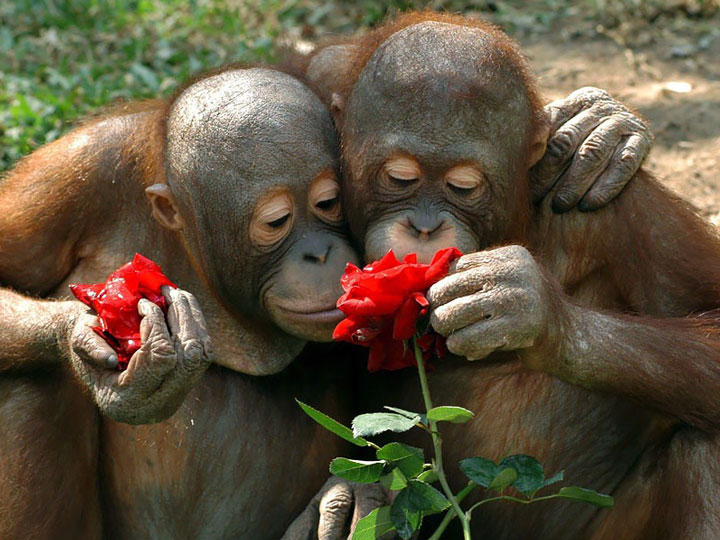
When people are sharing we must learn to listen like a tree – silently and without any judgements. Often when people are sharing a difficult experience, what they are seeking is for someone to be present to their experience. The intention is to feel less alone in it, and thus lessen the intensity of it. When you listen to someone and assure them of your non-judgmental presence, you are communicating to them that they are not alone, that we are in this together, that this experience is shared and they do not have to suffer alone.

REFERENCES:
The Eight Master Lessons of Nature by Gary Ferguson | The Age of Empathy by Frans De Waal

TEACHING EMPATHY WITH NATURE

Given below are the list of tasks that we recommend. Also included are some nature insights that can add value and new learning to your walks. Feel free to  add / edit / modify these asks to suit your environment as well as group interests.

This kindness walk is suitable for all age groups. It can be especially helpful for teaching the concept to kids and to younger audience. However, it is equally effective for folks who wish to deepen their enquiry of the Self.

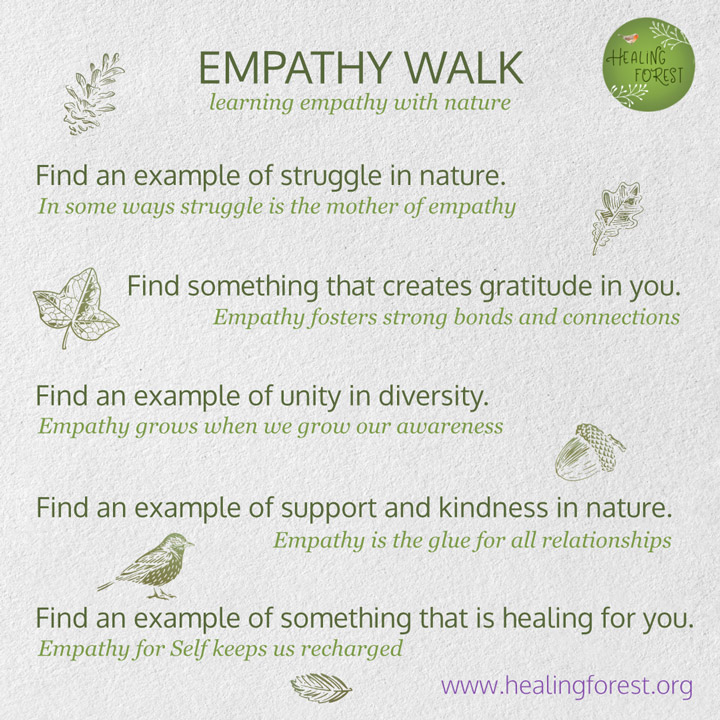
1. STRUGGLE: Find an example of struggle in nature.

From the moment we’re born, we need nurturing, human connection and empathy in order to survive. It’s simply a biological imperative. As mammals, it’s critical that we receive maternal care. This initial bond is so important that it continues to reverberate through our lives as we get older.

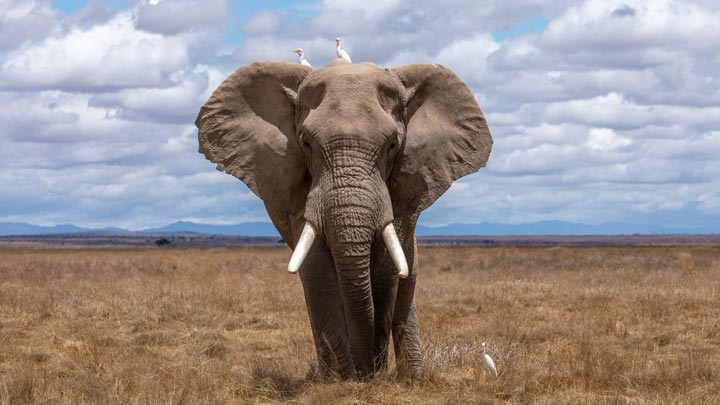
In many species, the eldest creatures in a community are responsible for showing younger members crucial skills for survival. A wonderful example of this can be seen in the African Elephants. The elephants in the savannah are led by the eldest females of the herd. They protect the young with their large tusks and tap their impressive memories to locate hidden watering holes. In larger groups of elephants, when one dies, its herd gathers together, gently touching trunks in what appears to be a grieving ritual.

Poachers hunting mature elephants leave many herds without any elder leadership. Scientists have observed that these packs with no grandparents are often less cohesive, more aggressive, and generally less able to thrive.

By observing different examples of struggle in nature, we can reflect on how in the journey of our own life, we have encountered different struggles. It is also a moment to observe that no life in nature is free from challenges and struggles. And in some ways we can say that struggle is the mother of empathy.
Pic By: Nam Anh
2. GRATITUDE: Find an example of something that creates gratitude in you.

While empathy is generally associated with feeling the other’s hurt or loss, it can be an equally powerful bond in expressions of fulfilment and gratitude. After a dry spell, when the first rain arrives the entire forest celebrates. Creating small moments of gratitude provides encouragement and support to move through difficult times.

The Work of the mature person is to carry grief in one hand and gratitude in the other and to be stretched large by them. How much sorrow can I hold? That’s how much gratitude I can give. If I carry only grief, I’ll bend toward cynicism and despair. If I only have gratitude, I may become saccharine and not develop much compassion for other people’s suffering. Grief keeps the heart fluid and soft, which helps make compassion possible.

~ Francis Weller

Imagine a mighty oak tree – how does it survive? It relies on soil and sunlight and also on other organisms. Deep underground, its roots are entangled with mycorrhizal fungi. The tree provides the fungi nutrients and in return, it receives essential elements like nitrogen and phosphorus. But the connections don’t end there. Through the rhizomatic network of fungi underground, a whole forest of trees can actually communicate with each other. Trees struggling to grow can send chemical signals asking for help and, through the fungi, thriving oaks can deliver needed nourishment.

Humans are not separate from this web of life. Trees emit antimicrobial compounds called phytoncides. Walk through the forest and you’ll inhale these beneficial compounds which can boost your immune system. This rich system of mutual support recalls the concept of ubuntu. This notion, from the Nguni people of southern Africa, describes how humans can only flourish through sharing and empathy. No one is truly a “rugged individual,” we only survive when we all care for each other.

3. INTERCONNECTEDNESS: Find an example of unity in diversity.

Hike through the unspoiled wilderness in the springtime and you’ll come upon an amazing sight. In the fertile valleys between the peaks are meadows brimming with wildflowers. Importantly, there’s not just one species. The colorful display can include many different species. In our wilderness, we find geraniums, buttercups, paintbrushes, bluebells, and dozens of other blossoms. Why such a wide array? Well, each has its own strength. If there’s a drought, those with deep roots will endure. If there’s a blight, those with immunity will pull through. The surviving species will in turn keep the ecosystem going until the others have a chance to recover when conditions change. Essentially, variety is nature’s safety net.

As humans we have the ability to extend our empathy to encompass a large variety of beings. By learning to expand our level of awareness and circle of observation we become aware of different people and creatures in our lives that may be in need.

Empathy also plays a role in cooperation. One needs to pay close attention to the activities and goals of others to cooperate effectively. A lioness needs to notice quickly when other lionesses go into hunting mode, so that she can join them and contribute to the pride’s success. A male chimpanzee needs to pay attention to his buddy’s rivalries and skirmishes with others so that he can help out whenever needed, thus ensuring the political success of their partnership. Effective cooperation requires being exquisitely in tune with the emotional states and goals of others.

4. KINDNESS: Find an example of support and kindness in nature.

Empathy helps to create more effective teams. As a whole, the team is only as strong as our weakest team member. When one of our team members faces a setback, it is important that the team works to reach out, support and care for them until they are ready to fly again. By supporting the weaker members, the teams set a culture of belonging and strong sense of community. The herd instinct plays a vital role in the bonding experienced by both humans and animals.

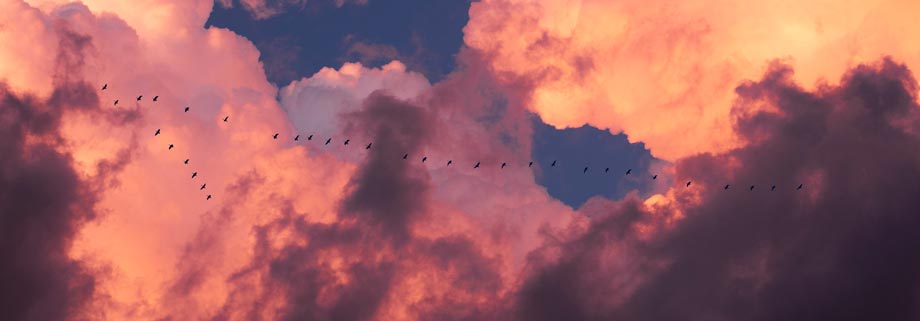
Empathy in action: If you look up at the birds flying in the sky, you might notice that many flocks fly in a V-shape formation. There is an interesting reason for this formation.

Flying takes a lot of energy. The strong flapping of wings creates an updraft in the air around the bird’s wingtips. Birds which fly slightly behind the first bird take advantage of this updraft and have to spend lesser energy to fly. When the leading bird gets tired, it drops back in formation and another bird moves to the front. For long migratory flights the youngest and weakest birds are put at the back of the V formation to make the flights easier for them. In fact, one study found that geese can increase their range by 70% on long migratory flights using this technique.
Pic by Nicole Geri
5. HEALING: Find an example of something that is healing for you.

Empaths are highly tuned in and sensitive to the emotions of others, they often have a natural ability to absorb emotional energies around them and transform them into more healthy, positive forms through their expression of love, compassion, forgiveness and understanding. Feeling other people’s pain and anguish compels us to alleviate it – not just for the other person, but also for ourselves, so that we no longer feel its torment.

This process of transformation is frequently exhausting and depleting for the empath. When we spend too much emotional, mental and physical energy while caring for someone else, it results in an empathy burn-out. During this experience, we tend to suddenly withdraw our attention and become dispirited towards the ones we care about the most. Under the weight of our own exhaustion, we feel numb or unaffected, emptied of all energy, vitality and feelings.

In order for us to preserve our capacity for empathy for others, we need to establish healthy boundaries for ourselves, so that we can continue to respond to the feelings of others without being engulfed by them.

AVOIDING EMPATHY FATIGUE

Some simple things to keep in mind are:

  1. Set aside time to recharge yourself. During this time, you allow yourself to walk away from your caregiving task, and instead engage in activities of self-care that you find replenishing. An excellent idea is to go for a Healing Forest walk or try Forest Bathing.
  2. Understand that you do not have all the answers. If you put on yourself the burden of having a solution to every problem that arises, you will burn out quickly. Be confident that you will help where you can, but when you don’t know how, that’s okay. Someone else can step in with those answers.
  3. Tell yourself that whatever you are doing is good enough. You do not need to be great. An acceptance of your capacity and its limits is more healthy than setting up unrealistic expectations from yourself which lead to a sense of failure and guilt.
  4. You might feel that setting boundaries for showing empathy may seem selfish. However, it is important to bear in mind that in wanting people to heal, ultimately we want to foster their ability to do so on their own. Setting boundaries while being lovingly available to the other helps not just in recovery but also in building their sense of self-reliance.
Reference 1, 2

Download link for the empathy walk poster.

WHY EMPATHY & KINDNESS ARE IMPORTANT

Empathy is one of the fundamental life skills that needs to be mastered in these complex times. In a world that is becoming increasingly interconnected, kindness helps us expand and grow our relationships. Empathy is also the lifeblood that helps us nurture and sustain those relationships.

The most important take-away from the nature walk is the fact that our empathy is not restricted to just other human beings. It has to expand itself to include other species and our environment as well. As technology advances, it is bringing different cultures closer in contact with each other. And the actions of humans are influencing our global environment at a remarkable pace. Last year, an intergovernmental panel of scientists said one million animal and plant species were now threatened with extinction. And global populations of mammals, birds, fish, amphibians and reptiles plunged by 68%, on average, between 1970 and 2016 (Source BBC).

Therefore, it has become critical to grow our levels of empathy as a community, as well as a species. Unless we focus on learning and teaching empathy and kindness through nature, we cannot hope to create a fruitful relationship with our future.

To get uplifting new ideas that help you grow in life, you can join our free newsletter.

Healing Forest is a volunteer driven project that aims to bring people and forests closer to each other through creativity and mindfulness. Our aim is simple. Helping people heal. Helping forests heal.

Request: Please share this post so it reaches those who might find it helpful. 
Pic by Elena Vell / FB

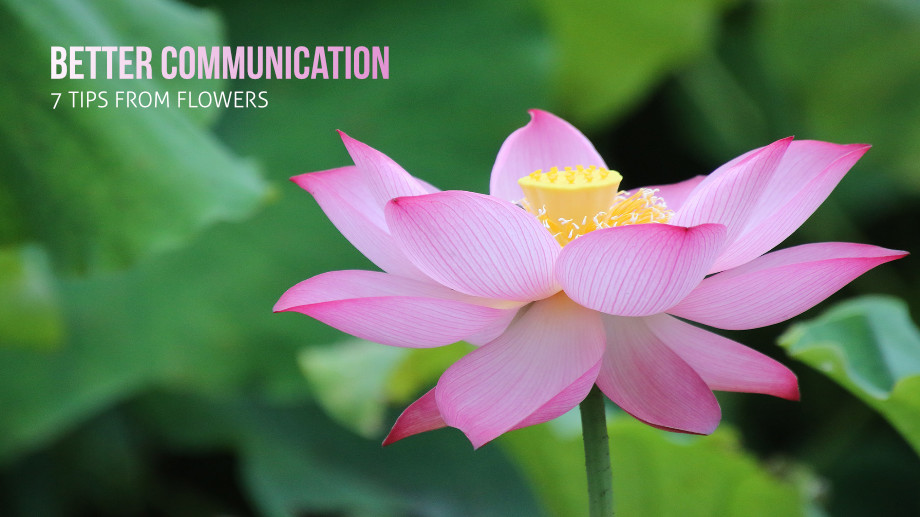
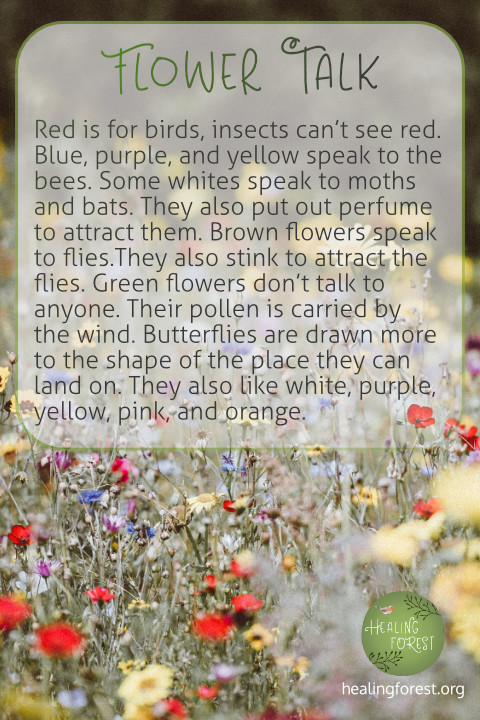
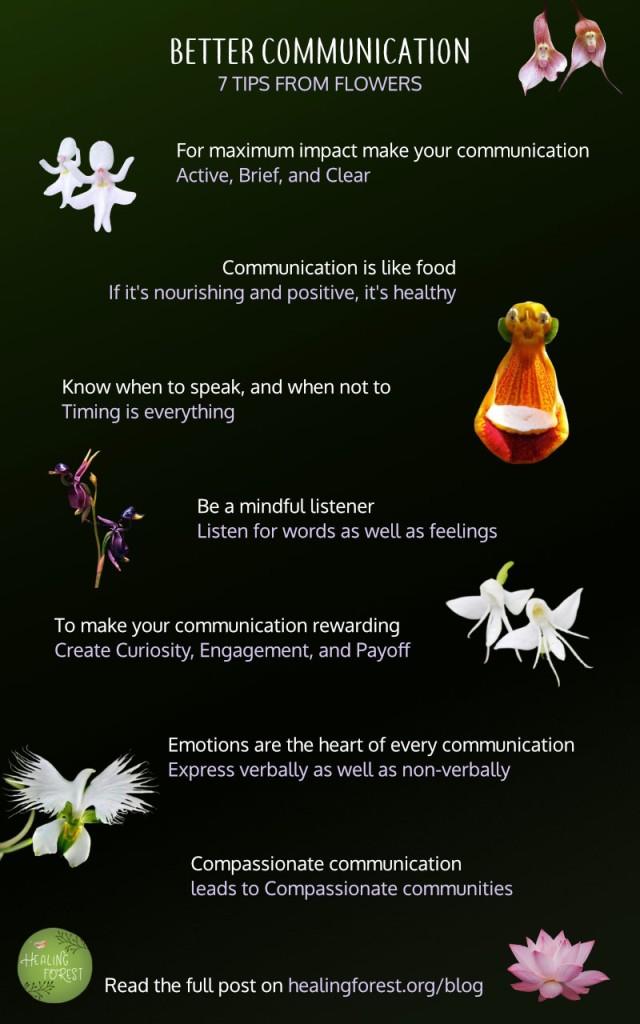
Flowers have mastered the art of communication over a hundred million years. They have crafted and perfected this skill because their very survival depends on it. What the flowers have realised is that great communication is a mix of the visible and the invisible.

In this article you will find 7 useful tips from flowers on how to better your communication skills. *And don’t miss the flower games at the very end – simple activities that will help you speak, write, and listen better. There’s also a short film and a surprise gift for the patient ones.

Need For Better Communication

Every effective communication is an exchange. Of ideas, emotions, and attention. Our ability to express ourselves plays a very important role in connecting us to others and connecting others to us. The relationships of our life are bound by communication – both visible and invisible. If we observe the patterns that help us grow in life, we find that communication is one of the integral qualities that shapes our journey. Mothers, teachers, influencers, change-makers and wise masters – all know how critical the art of communication is.

When we analyse the problems in any relationship, whether at home, at work or with our closest friends, we find that communication is failing. By mastering the art of communication and improving our skillset, we can succeed in creating healthier relationships and more joyful interactions in life.

For more magical walks and activities that help you solve life’s greatest puzzles, try: Nature Play>>

Yet, such a vital skill is not given the importance it is due, and a large number of people struggle with it. By exploring how flowers talk – attracting bees, butterflies, moths and birds – and understanding the methods they have evolved over time, we will find useful metaphors to make our own communication more beautiful. A few simple tips will show us how to become better communicators so that we can create stronger connections in our lives.

ARTICLE REFERENCES: Thich Naht Hahn (Art of Communication) | J.D.Schramm (Communicate with Mastery) | Stephen Buchmann (The Reason for Flowers)

Better Communication | What Flowers Know

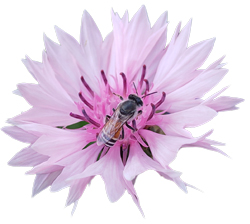
Among the most beautiful innovations of the natural world are those remarkable bursts of colour we call flowers. Despite their tremendous beauty, flowers have a major problem: Flowering plants cannot survive on their own, and instead depend on pollinators for their procreation.

To do so, they have developed an ingenious means of advertisement, which primarily uses their vivid colours and enchanting fragrances. In fact, a flower’s colour is specifically designed to garner attention. Insects cannot see as well as we do, and the brighter a flower, the easier it will be for a pollinator to recognize and visit it. As a result, flowers boast the most highly saturated colours found in nature.

Better Communication Tip 1: Design for Impact

Given the flood of communication all around us and the ever shortening attention span of people, it is essential to design our communication for impact. Amidst all the clutter and cacophony around us, it is not an easy task to create messages that stick in the mind.

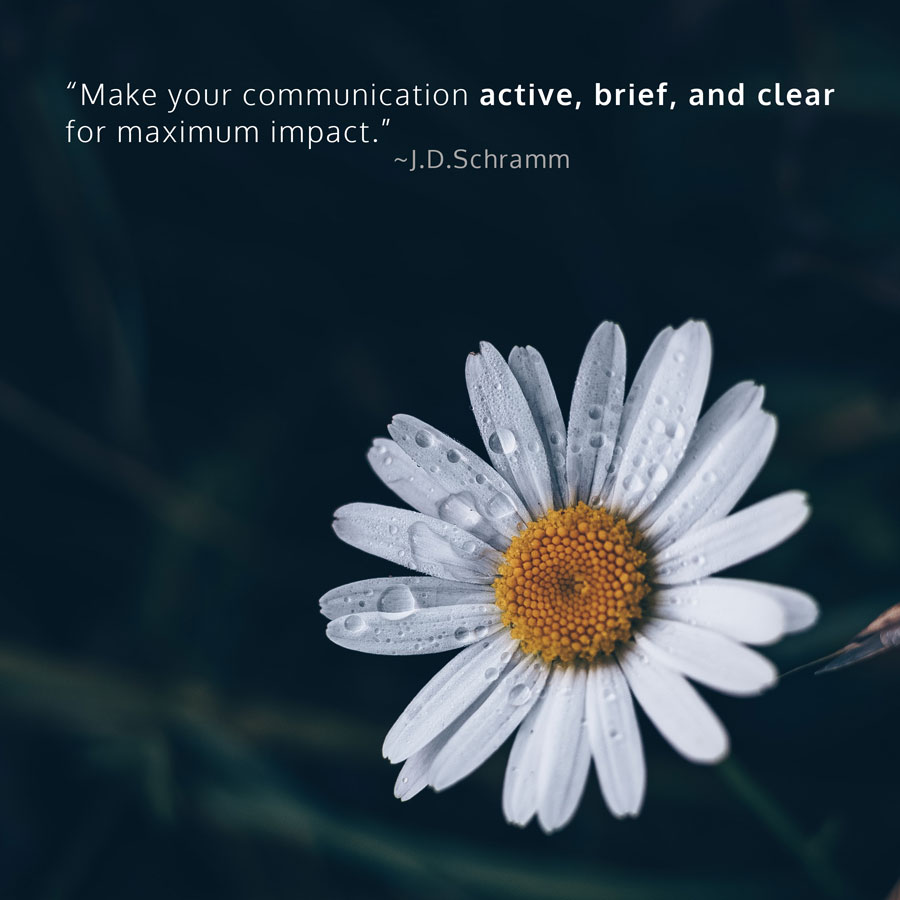
Here’s an ABC tip from J. D. Schramm, founder of the Mastery in Communication Initiative, at Stanford Graduate School of Business: Make your communication active, brief, and clear for maximum impact. Think: What? So what? Now what? The ‘what’ is the information you need to share. The ‘so what’ tells you why this information is relevant. And the ‘now what’ articulates what action is needed. It’s great to have persuasive and meaningful content, but it also needs to be pleasing to the eye. This helps your reader take in the information as intended.

Better Communication Tip 2: Craft it to serve the audience

Flowers reward pollinating insects handsomely for their services. Flowers are like a kind of café or a rest stop for insects where they can eat, drink, and take a break. Not only that, flowers are also an ideal location for insects to find mates and, in colder parts of the world, the inside of a blossom can even be comfortably warm.

To become an effective communicator, first, we must understand our audience. By understanding their needs, perceptions and current level of understanding, one can create communication that is healthy for them. But what exactly is “healthy” communication?

Master Thich Naht Hanh says: It’s best to think of communication like food. Some of it is nourishing, and some is toxic and poisonous. Nourishing speech is understanding and positive, while toxic speech fills people with negative emotions like anger and frustration.

In order to communicate well with another person, we first need to understand ourselves. However, most of us rarely communicate with ourselves in a healthy way, which is why we may have some trouble communicating with others.

Better Communication Tip 3: Time it well

Over the centuries, plants have evolved to flower at a time that ensures maximal reproductive success. Not just the season of flowering but also the time of day during which they flower and for how long they stay open has been carefully crafted through a cycle of learning, failure, and success.

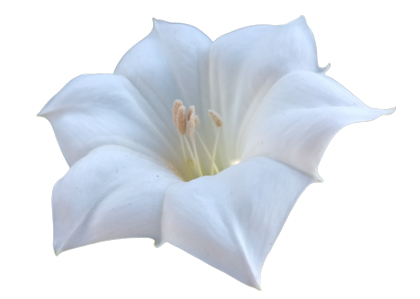
For example ‘Moon flower’ is the common name for a variety of plants that have flowers that open at night. They do this because night-flying insects mostly pollinate them. One such insect is the hawk moth. The flowers are sensitive to small changes in light so they open when these insects are out in the evening.

Experts in communication know that timing is everything. What to say, when to say it, and how much to say, are all questions that one must think about before engaging in important conversations. The difference between an average and an excellent communicator is this ability to master the timing of delivery. Knowing when not to speak is as important as knowing when to talk.

In Frank Luntz’s book Words that Work, he states that “Communication is less about what you say, and more about what people hear. It is therefore important to focus on what people are likely to hear to sidestep saying the wrong thing or having your message misconstrued. This is why certain words are deeply triggering for certain communities.”

For example, we know teenagers won’t respond very well to communication very early in the morning. And while good news can be given any time, if you are going to deliver some bad news, make sure you wait for a suitable time.

Better Communication Tip 4: Improve your listening skills

Scientists have found evidence that plants can actually hear the buzz of passing bees and produce sweeter nectar in response to entice the flying insects in. Flowers are technically the ‘ears’ because of their conical shape which feel the sound waves rather than hearing them.

Based on observations of evening primroses, the team behind the study discovered that within minutes of sensing the sound waves of nearby bee wings through flower petals, the concentration of the sugar in the plant’s nectar was increased by an average of 20 percent. The flowers even seemed able to tune out irrelevant background noises, such as the wind. ( Learn more at this link)

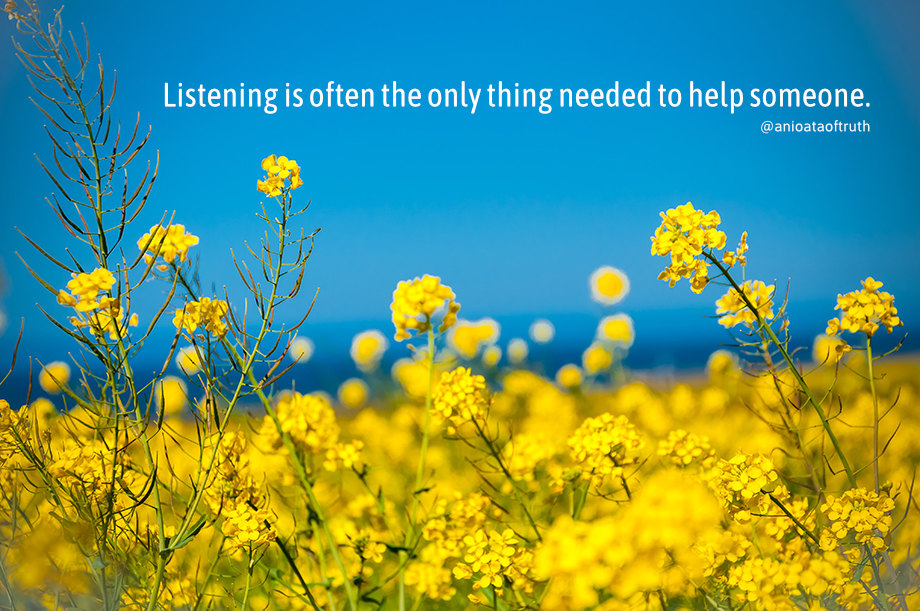
Being a good listener helps solve problems, resolve conflicts, and improve relationships. In the workplace, effective listening contributes to fewer errors, less wasted time, and improved accuracy. Knowing how to improve your listening skills can help you build not only friendships but also careers.

To be a good listener, one needs to be mindful of our own thoughts. Practicing mindfulness helps us become aware of the chatter in our heads and we can learn to redirect our attention to the other person. Then we can hear not only what they are saying, but also sense what they are feeling.

We don’t always fully understand people that are close to us. This is often because we don’t listen to each other. Mindful listening means carefully taking in what others say without judging them. When the person you’re communicating with sees how much you care about understanding them, that alone will lay the foundation for good communication. When someone’s telling you about their thoughts, you might be tempted to interrupt them, especially if you want to correct their perceptions. However, this might lead to a discussion where you are not truly focusing on their feelings, which is what you should be doing.

Better Communication Tip 5: Create curiosity, engagement, and payoff

The most appealing thing flowers have to offer is deeply nutritious food, namely their sweet nectar. This sugar-rich, high-energy food is stored deep inside the flower, forcing pollinators to immerse themselves in the bloom, thereby covering their bodies with the flower’s sticky pollen, the grains of which are also edible and a good source of protein. While it is easy to get to the flower, the seeker has to put some effort to reap the benefits.

Building curiosity and pay-off into your communication are the hallmarks of excellent communicators. They are able to pull the audience towards them rather than push their words on unsuspecting candidates. In classrooms with a captive audience, when teachers forget this golden rule, they lose out on engaging with their class.

Just like flowers, one of the fundamental reasons we communicate is to spread our ideas. For this endeavour to be successful, listeners should be an active part of the conversation. When listeners feel that the information adds value to them, they begin to own the ideas. That is how the message will travel far and wide.

Better Communication Tip 6: The Invisible

Although flowers can be identical in their colour or shape, there are no two floral scents that are exactly the same. The different scents allow insects to discriminate among plant species and even among individual flowers of a single species. (Source link)

“The best machines that we have can really detect these floral scents maybe a few meters away from the flower, but we know from observations that pollinators can detect floral scents from up to a kilometre away.” ~ Jeremy Chan, University of Washington.

The scent represents the invisible aspect of every communication – the emotions. While words can only go so far, it is the emotions which travel far and wide. The biggest difference between average and stellar communication is the depth of emotion it conveys.

The invisible component of every communication also includes eye contact, posture, gestures, facial expression, body language, and personal appearance. More than half of what we communicate is non-verbal through our body language and mannerisms, as well as the way we use the space and the items around us. All these aspects combine to create an emotional impact.

Just like the sense of smell has a direct connection to the brain, emotions have a way of permeating into our hearts. For every piece of communication that touches us, it is the emotions which are absorbed, retained, and passed on.

Better Communication Tip 7: The Community

During flower development, newly opened and young flowers, which are not ready to function as pollen donors, produce fewer odours and are less attractive to pollinators than are older flowers. Once a flower has been sufficiently pollinated, changes to the floral bouquets and reduction in the scents lead to a lower attractiveness of these flowers, and this helps to direct pollinators to un-pollinated flowers instead, thereby maximising the reproductive success of the plant.

The best communication is inclusive communication. In a group, no person should feel unheard or left out. Learning to grow your communication circle is the most important part of the communication process. Knowing how to empower others to share their voice creates richer and more meaningful conversations. Like the flowers we should all strive to communicate with compassion. By creating space for others to speak and listening mindfully when they do, we can form highly engaged groups.

Remember the end goal of good communication is to build stronger bonds with those around you. And by sowing the seeds of compassionate communication we are allowing the growth of compassionate communities. Communities that will spread joy, peace, and beauty into the world at large…. just like the flowers! 🐞🦋🌺

Flower Games: Activities For Pairs

Here’s a collection of some creative exercises that help you become a better speaker, writer, listener. Try them in pairs or very small groups. The most skilful path to communication involves taking in how we and our partner feel, and tending to what we both need in the moment.

Short and sweet:
Describe any flower in 3 words without naming it. Your partner has to guess the flower you are describing.

Metaphor and me:
Describe yourself in nature metaphors. e.g: As gentle as a breeze, as aloof as a cat… and so on. Use at-least one metaphor that includes a flower. Keep exchanging metaphors with your partner until you run out of ideas.

Calling bees, birds, butterflies:
Imagine you are a flower and your partner is its pollinator. Create a short compelling advertising pitch for yourself, to attract the pollinator to your flower.

A new vision:
Create a new name for any existing flower. See if you can create a short poem about the flower and use the new name in it.

Note of appreciation:
Write a letter of appreciation from the point of view of your chosen flower. In the letter, find good things to say about the flower’s parent plant, the pollinators, to nature that has helped it grow, and even the person who is admiring it.

Flower song:
Sit with some flowers. Listen to their song in silence. Share what you heard and felt with your partner.

What other flower games and activities can you suggest? Leave a comment to share your thoughts and insights in the comments below.

Summary: How to improve your communication skills

END NOTE: The next time you start a conversation, think of the flowers. Let them remind you of all the visible and invisible ways your words can weave their magic. For more interesting activities from around the world, check out: Nature Calm

*To get useful new ideas that uplift your life, join our free monthly newsletter. Healing Forest is a project that aims to bring people and forests closer to each other through creativity and mindfulness. Our aim is simple. Helping people heal. Helping forests heal.

REQUEST: Please pollinate this post so that it reaches those who might find it helpful. *And here are some flower gifts for you before you go.
One of the things that makes humans unique is our ability to walk upright. It’s a big part of who we are. Moving around might seem simple, but it requires a refined use of our brain power. In this post we explore the connection between walking and our brains, and how we can transform our nature walks to create healthier minds.

These days, we seem to be walking less and less. With easy access to cars and public transport and our work shifting to desks and screens, there are less reasons to go outside. And very often the design of our congested cities does not give us easy access to good walking routes. This sedentary lifestyle takes a silent toll on our health over time.

Let us show you some exceptionally beautiful nature trails around the world and explore the complex science behind how humans walk, revealing a process that boosts our mood, creativity, and sociability. We hope these notes will inspire you to walk and wander more. *Don’t miss the short film at the end.

CREDITS: The health tips for this article have been taken from a wonderful book called ‘In Praise of Walking‘ (2019). It examines the science behind one of the basic skills that defines us as human beings. The author, Shane O’Mara is a Neuroscientist and Professor of Experimental Brain Research at Trinity College Dublin, Ireland.

CHINA

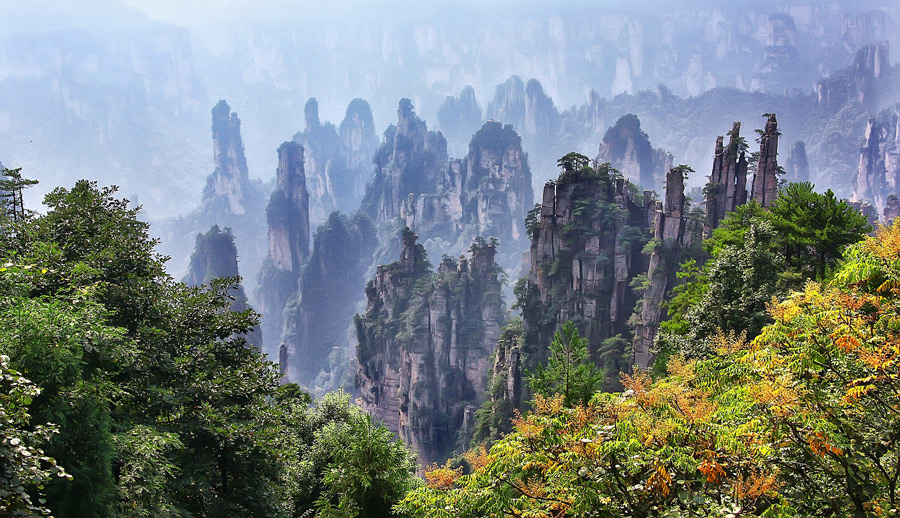
One of the most extraordinary nature walks on our planet is through the otherworldly Zhangjiajie National Forest Park. Its strange mountain spires topped with grass and trees have been an inspiration for Chinese landscape paintings through centuries. The spires — over 3,000 of them — are made of quartz and sandstone that has eroded over time, leaving crooked towers soaring into the sky. When the fog lingers along the tropical forest below, the rock towers look they’re wafting above it. The floating mountains in Avatar were inspired by these awe-inspiring formations.

The park is in Hunan province, far enough from China’s major metropolitan areas that it was unknown for a long time.To avoid the crowds, spend time hiking in the lower elevations and skip the cable car, elevator, and other areas where tourists concentrate. Your entrance fee also gives you access for four days, so you can explore some of the less-traveled areas of the park, such as the Yangjiajie Scenic Area where a steep two-hour hike leads to an amazing view.

Nature Walks China

Nature Walk Tip: Walk with your senses

Your brain has two modes: an active mode and a default mode. When your brain is in active mode, it’s focusing on a task, doing stuff in detail – counting something, for example. In default mode, your mind is free to wander, exploring and processing memories. That’s not as frivolous as it sounds; it’s vital for keeping your brain in order and your thinking sharp. Evidence suggests that creativity occurs when these two modes of thinking occur simultaneously. And walking is a great way to encourage the brain to do exactly that. Walking – or more specifically, spatial navigation – stimulates the part of the brain around the hippocampus, which is also the part of the brain that’s active in memory

Contrary to the traditional form of walking as an exercise, the Japanese form of mindful nature walks also known as forest bathing invites you to take a slow walk in nature. By focusing on your senses and soaking in the gifts nature, we can access a range of health benefits for our mind, body, and spirit. Numerous studies confirm forest bathing’s ability to ease high blood pressure, digestive challenges, anxiety, mild depression and insomnia. spirit. According to one study, future cases of depression could be lowered by around 12 percent if everyone spent just one hour a week doing physical activity.
For more info: What is Forest Bathing?

USA

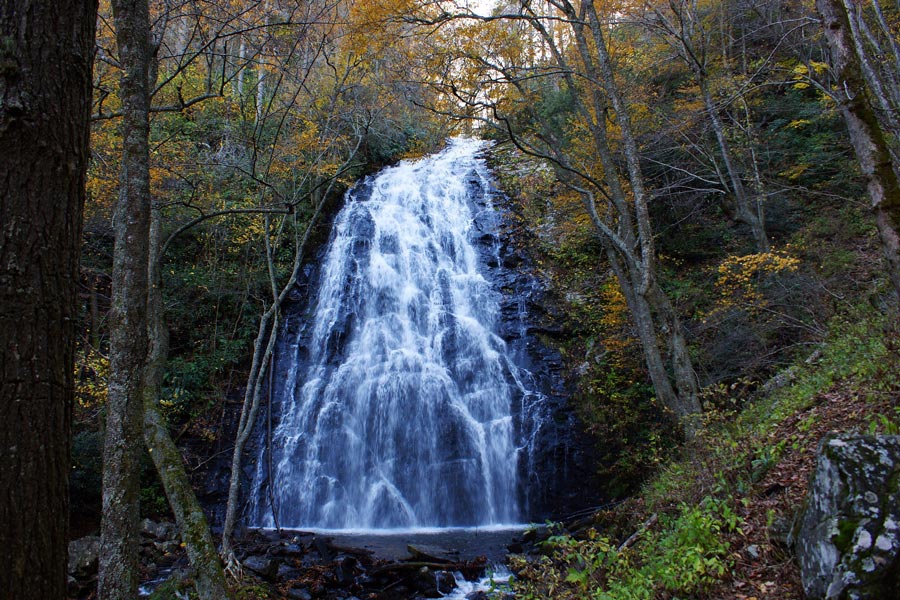
The Appalachian Trail is the longest hiking-only footpath in the world, ranging from Maine to Georgia. From the spiky, tree-clad mountains of the south to the wind-whipped mountain ranges of in the north, beauty is not the exception but the norm. A spectacular range of scenic nature spots, spread across the trail reveal themselves to keep the walker enchanted.

The Trail is not only as a project in land conservation, but as a way for all human beings to find solace, optimism, and rejuvenation during a time of “general upheaval,”. ~ Benton MacKaye

One can visit various parts of the trail for day hikes, and some go even farther, even to the point of attempting a thru-hike, in which they hike the entire length of the trail in one season. The most ambitious hikers do a “yo-yo” which involves hiking the whole trail from beginning to end and then back again. Obviously, this takes lots of time and stamina!
Fore more info visit: https://appalachiantrail.org/ | Beautiful sections of the nature walk.

Nature Walks America
Pic by Tony Glenn

Nature Walk Tip: Getting Lost

Neuroscientist John O’Keefe has made some pioneering discoveries regarding how the brain. He discovered that our brains contain place cells – they tell us where we are and they work most effectively when we walk. Further research has revealed even more fascinating types of cells in the brain that help us get around. Head-direction cells are essentially an inner compass, indicating our orientation. There are also cells that respond to nearby objects. All in all, the brain more or less has its own GPS network.

Once in a while try walking in an area that you have no idea about. Let your internal sense of direction guide you. Explore things that fill you with awe, wonder, and fascination. Let the signs of nature, the direction of shadows, the sounds on the wind, and the path of the sun guide you. Making walking a habit can preserve your memory. Researchers following up on 300 older adults after 13 years found that those who had walked six to nine miles a week lowered their risk of memory problems by 50 percent.
Research Source

ITALY

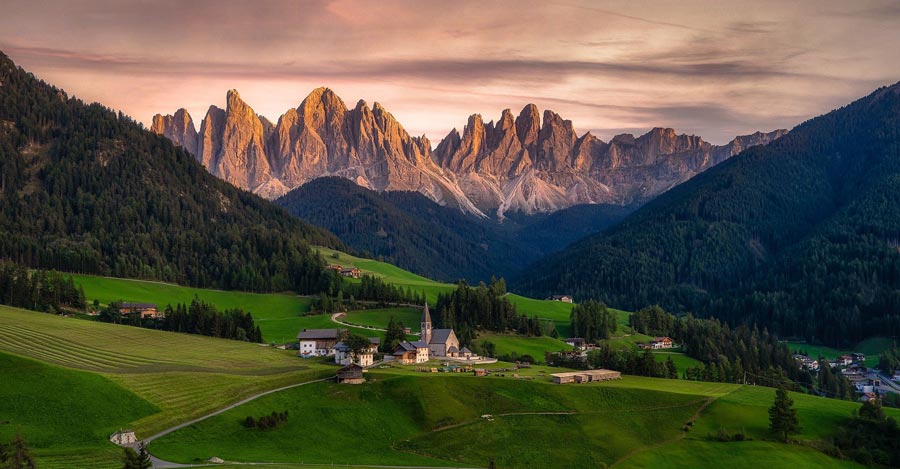
With their colossal limestone walls and gloriously green valleys, Italy’s Dolomites are home to some of the world’s most majestic scenery — and mountain huts called rifugios make it all the more accessible.

A monumental mountain range in northeastern Italy, the Dolomites have been declared a World Heritage Site since 2009. There are several Alta Via routes, but the AV1, with fewer exposed sections, is ideal for less experienced hikers. The rifugios or traveler’s huts are normally open from June to September.

On the walk you can wander through lush Alpine grazing lands and valley floors carpeted with pine and fir trees. Largely because of the beauty of the pale dolomitic limestone, panoramic vistas are a constant. Experience an exquisite glow that happens at sunrise and sunset, when the dolomitic limestone is bathed in gorgeous peachy-pink hues.
For details and a travel story visit this link.

Nature Walk Tip: Staying Healthy

Given our boxed-in, busy daily lives, it’s especially important to have a moment of calm as part of your daily routine. But, unfortunately, our cities don’t make it easy for us. Over half the global population lives in cities and urban areas – and that will probably rise to 80 percent by 2050.

Researchers sent a group of walkers into a forested area, and another walkers group into a city, for an hour. Afterward, the forest walkers had improved heart and lung function; the city walkers didn’t.

Walking in nature is known to boost our immune function. Walking can help protect you during cold and flu season. A study of over 1,000 men and women found that those who walked at least 20 minutes a day, at least 5 days a week, had 43% fewer sick days than those who exercised once a week or less. And if they did get sick, it was for a shorter duration, and their symptoms were milder.
Source: Harvard article on health benefits of walking.

PERU

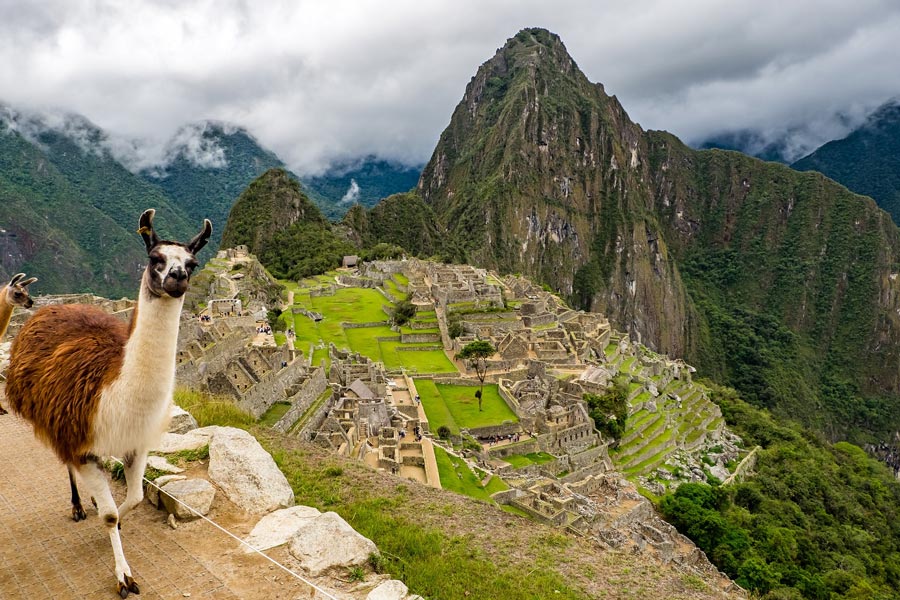
In a country known for exceptional trekking, one of the most iconic trails is the walk to Machu Picchu on the Inca Trail. There is the Salkentay route where you can rest in comfort each evening of the hike. But if you’re seeking an alternative route to the illustrious ruins, then perhaps the Choquequirao trek is more apt. Known as The Cradle of Gold, Choquequirao is a former Inca stronghold isolated in the cloud forests above the Apurimac River. It’s just as impressive as Machu Picchu but it’s only accessible by foot, eliminating the likelihood of encountering crowds.

These walks are a journey back in time. A walk among the cloud filled forests makes the memories of our present day hassles fade away into the distance. And when you arrive at the ruins set amidst the magical mountains, we receive the gift of briefly living the lives of ancient civilisations through our imagination.

Nature Walks Peru
Pic by Mailan Maik

Nature Walk Tip: Finding Answers

You’ve probably heard people say you should “sleep on” a difficult question – but why not also try “walking on” it? Next time you have a challenging problem to solve at work, give it a go.

Biomimicry is a scientific practice that learns from and mimics the strategies used by species alive today. It offers an empathetic, interconnected understanding of how life works and ultimately where we fit in. There are many examples of exceptional ideas that have come from observing nature. From the flight of planes, the bullet train, or the humble velcro. On a more philosophical note, walking in nature can help us find answers, because we are a part of nature too. The patterns and problems of our inner world are often mysteriously reflected in the art of nature outside.

NEW ZEALAND

Welcome to a walker’s paradise, where a network of trails winds past rugged coastlines, through farmland, river valleys and towering forest, to dramatic mountain ranges.

Scattered across the country, each within easy access of cities and towns, the tracks are well-kept and popular with both locals and visitors. Each route is different and offers a one-with-nature experience you can’t get anywhere else.

Walking and hiking throughout New Zealand is the best way to see beautiful landscapes and explore vast wilderness areas. Each Great Walk has been selected for unique combinations of cultural significance, exceptional scenery, and accessibility. Over the Great Walks season between October and April, huts along the tracks are equipped with flushing toilets, cooking gas, and other comforts that aren’t typically seen in DOC huts. As these walks are popular, will need to book these huts in advance.
For more info visit: https://www.newzealand.com/in/walking-and-hiking/

Nature Walks New-Zealand
Pic by Marina Cath

Nature Walk Tip: Making Friends

One study found that elderly people who walked for around 150 minutes each week were more socially active; they also had higher levels of well-being compared to elderly people who walked less. Walking is also a crucial step in young children’s social development – once they can walk, they both play and vocalize a lot more. Adults who walked for 40 minutes three times a week slowed age-related declines in brain function and improved their performance on cognitive tasks.

However, the most significant friendship we create is the one with nature itself. Those who know how to silence the mind to match the silence of nature, find a rare and invaluable gift in life. A space of unconditional acceptance and the freedom to know our true selves.

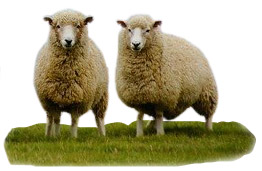
Nature Walk Sheep

Nature Walk Film

Watching this heart-warming short film by Gnarly Bay. Journey with them as they walk through Chile and Patagonia to find an important life message. Do watch in full-screen and with headphones if possible.

NATURE WALK SUMMARY

There are many ways one can benefit from standing up, leaving the house, and taking a stroll in Nature. By walking more we can boost our physical as well as mental health. It also helps us become more creative and social. The wonderful thing is that we don’t have to journey to the far corners of the world to experience its healing effects. Discovering the wild and wonderful in our own neighbourhood is the seed that flowers into our well-being. And our connectedness creates a lifetime of learning, wisdom, and growth.

Feel free to add your favourite nature trail recommendations in the comments below. What gifts and lessons have you received from your walks?

Healing Forest is a project that aims to bring people and forests closer to each other through inspiring stories, films, and articles . Our aim is simple. Helping people heal. Helping forests heal

REQUEST: Do share this post with those who might find it useful | *And check out our Nature Calm course for more ideas.