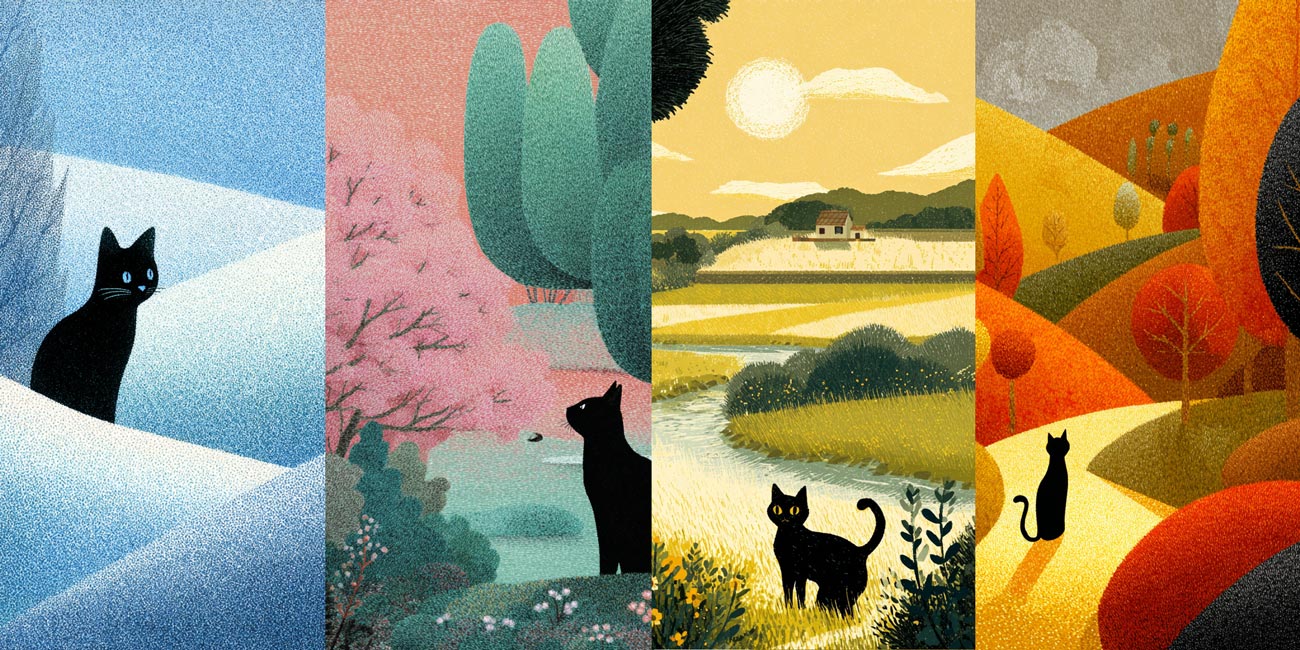
The nature of human nature is a study of opposites. Our mind holds many worlds: light and shadow, peace and restlessness, hope and sorrow, love and indifference. To understand the nature of human nature it to observe how it shifts, the way it flows, and to know the seasons of our own mind. Our inner life is not a straight line but a cycle, full of rise and fall, fullness and emptiness.

In this article we will use the metaphor of seasons to create a useful study on the nature of human nature. Each section will also have simple meditations and creative activities to help you deal with the negatives and transform them into positive emotions.

As always, we save the best for the last. At the end of this post is a beautiful time-lapse film from Denmark and links to activities based on your current mood.

Just as the earth moves through winter, spring, summer, and autumn, so too does the human mind pass through its own quiet seasons. Understanding this can bring relief and each stage in nature comes with its own lessons. Every season carries both beauty and hardship. Winter can bring anxiety, but also calm. Spring may stir loneliness, but also love. When we see our emotions as part of a natural rhythm, we begin to meet them with less fear and more tenderness. It is also a great way of knowing and connecting with others.

In Buddhist tradition, there are four positive emotions that help us stay steady through these shifts: loving-kindness, compassion, joy in the happiness of others, and deep inner balance. These are not fleeting moods. They are conscious practices for our mind. Seeds we can grow. Through them, we learn not just to survive the seasons of the mind, but to live gently and wisely within them.

Winter arrives quietly, often without warning. It brings short days, long nights, and a hush that settles over the landscape of the mind. In this stage our mind may feel distant, uncertain, or burdened by thoughts we cannot quite name. Worry creeps in like a chill, subtle, persistent. Anxiety grows in the silence, asking questions we cannot answer: What if? What now? What next?

It is natural to want to escape this season. But winter asks something different of us. It invites us to pause.

Practice: Sitting with Equanimity
Find a quiet place and sit comfortably. Close your eyes and place one hand gently over your heart. Imagine you are a tall mountain with a snow storm falling on it. Breathe slowly, in and out.
As you breathe, say softly to yourself:
“This is a moment of calm.”
“I do not need to fix anything right now.”
“Storms come and go”
“In me is a mountain of stillness.”
Let your breath be like the snow steady, soft, enough.

In this simple presence, the mind begins to settle. Worry loosens its grip. The gift of winter is a quiet strength that does not depend on the world being warm or certain. This is equanimity, the balance that allows us to bend without breaking. It does not erase fear, but it teaches us to sit beside it, breathing.

Spring arrives with warmth on its breath and green at its fingertips. There are times when our mind feels the pull toward connection, renewal, tenderness. Love awakens, not just for others, but for life itself. The heart softens. We smile more easily, feel more open, even hopeful. A bird’s song can move us. A kind word can open us. The world feels alive again, and so do we.

The negative aspect of spring, is the ache in our heart. We may feel lonely in the midst of blooming things. The thoughts might stir memories of what we’ve lost or never received. In the face of others’ joy, we may feel our own emptiness more clearly. Indifference from others, or even from ourselves. When love is not returned, or when we feel forgotten, spring can hurt.

Here’s a mindfulness activity to transform your inner nature.

Practice: Walking among trees
Take a walk where there are old trees. It could be a park, a forest path, or even a quiet street. Walk slowly, without hurry. Let your senses lead you. Feel the sunlight on your skin. Notice the sound of leaves in the breeze. As you walk, breathe gently and say to yourself:
“I am part of this world.”
“There is life in me.”
“I open my heart to what is here.”

Let the world around you remind you that you belong. That love is not only something you give or receive. It is something you are, simply by being alive.

Summer in our mind doesn’t ask permission. It arrives in full force – bold, hot, loud. The mind, can grow heated. Emotions rise quickly. Anger flares. We feel stretched, reactive, easily burned by the words or actions of others. Even love can feel overwhelming, too bright, too much. We are swept into irritation or resentment. It is easy to feel caught in the fire of judgment, directed toward ourselves or others.

But summer also carries life at its peak. Life that is vibrant, abundant, generous. If we can soften into the heat rather than fight it, we begin to see what’s underneath the anger: a wounded part of us that longs to be heard. This is where compassion begins. Knowing that the Sun falls equally hard on everyone. Fire burns everything in its path.

To shift anger to compassion, first remove yourself from the place of extreme heat.

Practice: A meditation on compassion
Find a quiet space to sit. Place your hands gently in your lap. Take a few slow breaths.
Bring to mind someone who is suffering. It could be yourself, or another. Imagine them as a small child who is hurting. See their face, their posture. Gently repeat in your mind:
“May you be held in kindness.”
“May you be free from pain.”
“May you know peace.”

If it is yourself you are holding in compassion, let the words be directed inward. Imagine cooling rain falling gently on hot skin. Let compassion be the shade you rest in, a kindness that softens the harsh sun of anger.

Autumn arrives with a softness that aches. There is beauty in this season, but also a quiet sorrow. We may feel a sense of ending. Things passing away, slipping through our fingers. Grief can surface here, sometimes from long ago, sometimes from yesterday. The mind may return to memories, to moments we wish we could hold just a little longer.

Loss of loved one gone, a change we didn’t choose, a chapter closing. In autumn, the heart feels this weight more clearly. It is a time of remembering, and sometimes of longing.

Yet even as things fall away, autumn surrounds us with color. The trees do not resist their own turning. They blaze in reds and golds, offering beauty even as they let go. In the midst of sadness, we find a quiet kind of joy: the joy of presence, of seeing clearly, of appreciating what is here now, before it fades.

This joy does not erase grief. It holds hands with it.

Practice: Colours of Gratitude
Go outside on an autumn day. Bring a small basket or simply your open hands. As you walk slowly, collect fallen leaves, each of a different color. Notice their shape, their edges, the way each one is perfectly itself. When you return, lay them out in front of you. Sit quietly and look at them. For each leaf you have collected, think of one thing that you are grateful for.

Breathe slowly and say:
“I welcome change.”
“I see beauty, even in endings.”
“I give thanks for this breath.”
“I give thanks for this moment.”

Let the colours remind you that even as things fall away, there is richness in the letting go. Joy, in this season, is not loud. It is the quiet warmth of knowing that you will be held by acts of kindness. Gratitude for small joys, will always be a part of our mind and your life.

To live is to move through seasons, not just around us, but within us. Joy and sorrow, calm and confusion, love and loneliness: all are part of the rhythm of being human. When we stop resisting these shifts, we can meet each one with mindfulness and compassion. We begin to see that none of it is wrong. It is simply life unfolding. This is the nature of human nature: ever-changing, deeply feeling, and always returning to balance, like the earth itself.

*To get useful new articles in your inbox once a month, join our free monthly newsletter.

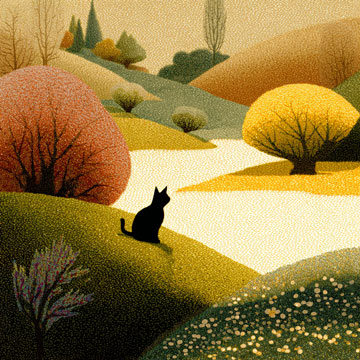
What’s Your Nature?: As a playful exercise, ask yourself and your close friends a simple question: “What is the city or a geographical area on Earth that would best depict your mood personality?” For example: You could be a Florida, a Siberia or a Rio Di Janeiro.

WINTER: Nature tips for tough times

SPRING: The art of loving

SUMMER: Dealing with anger

AUTUMN: How to let go

REQUEST: Please share this post so it reaches those who may need it. We are a small group of friends trying to find new ways to reconnect people with nature. The aim is simple. Helping people heal. Helping forests heal.

A Philosopher’s walk clears the mists of our mind, drives away the dark clouds and helps us find a path out of the brain fog.

There are days when life feels like a half-finished sentence. We move from one task to the next, one screen to another, gathering information but losing meaning. And then, we realise: we’ve forgotten to ask the big questions. Or maybe we’ve just been too busy to listen for the answers.

This is where the Philosopher’s Walk begins. This walk isn’t a race. There’s nothing to achieve. It’s simply a gentle invitation: to walk, to wonder, and to rediscover the art of reflection in good company, with nature as our guide.

The Philosopher’s walk helps you create a map of the most important things in your life. Amidst all the cloudy thoughts, it shines a light on what your core essence is. When the clouds get too heavy they shed their load as rain. Similarly, when our mind is too full, it helps to pour down our thoughts on paper.

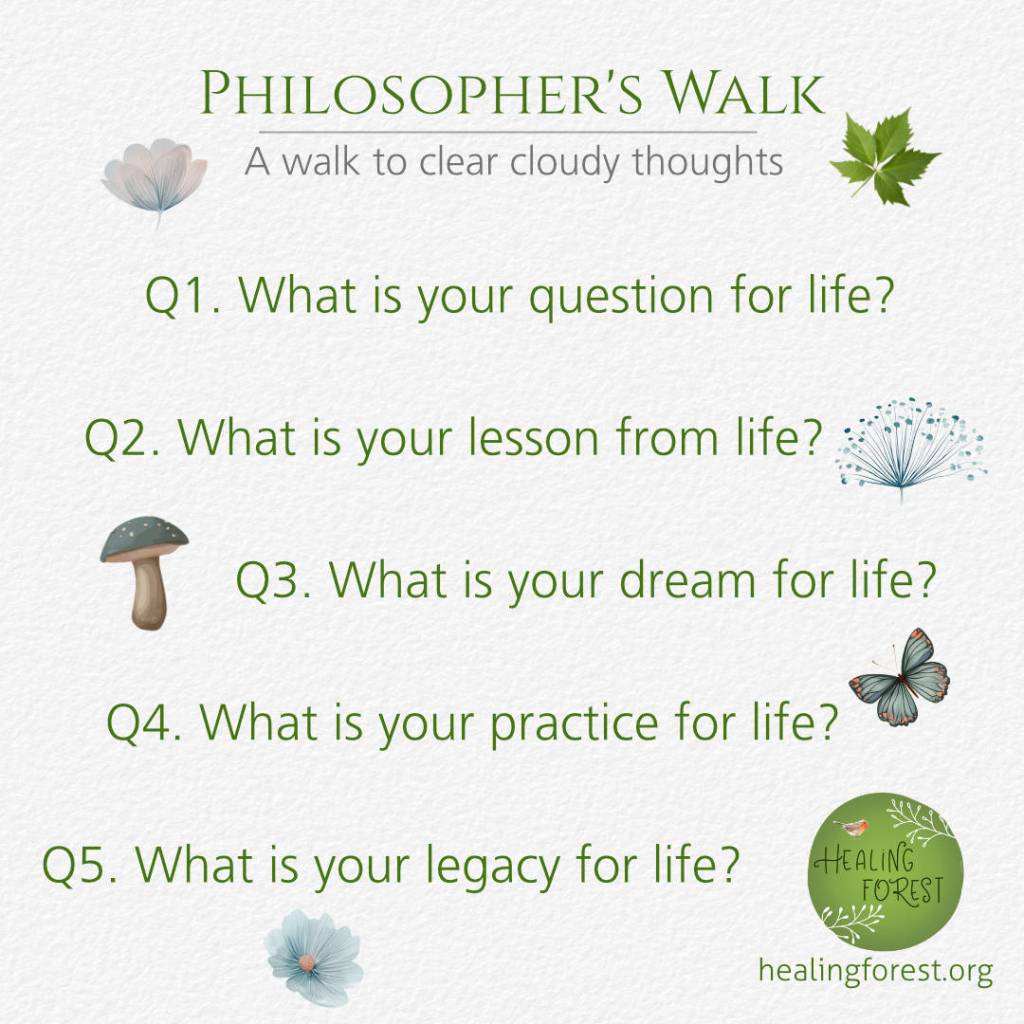
We will walk in five stages. At the beginning of each section, you’ll receive a question. Not the kind that demands a quick answer, but the kind that lingers in your mind. The questions serve as rays of light to guide us out of the stormy clouds. During the philosopher’s walk, you’ll stay with these questions, write what arises, and, if you like, share your reflections with others.

Here’s a calming 1 minute film from the mist mountains to get you in the right mood.

Bonus: At the end of each pause along the way is a window into the life of someone who once wandered among trees and came back with ideas that still speak to us. You’ll meet a few of these kindred nature philosophers as companions for the journey.

So take a breath. Take your time. And take a step. This is your Philosopher’s Walk.

What is the question that keeps showing up for you? Some people have a mission. Others have a calling. And some just have a persistent, quiet question that follows them through life.

Here are some examples that came up in our walks:

  • What does it mean to live well?
  • What is enough?
  • How do I stay true to myself?

You don’t need to find an answer today. Just find the question that refuses to leave you alone. Take this stretch of the walk to hold your question gently. Let it rise without forcing it. Write it down when it feels ready.

At the end of this section, you’re invited to share your question with others, if you like. Sometimes, someone else’s question sounds a lot like our own.

Philosopher’s Walk: A Walk with Thoreau

Henry David Thoreau once left the noise of the town of Concord behind and built a tiny cabin by Walden Pond. He didn’t go there to escape life, but to find it more fully. As he put it:

His question was simple but radical: Can a person live simply, purposefully, and still be free? He didn’t just ask it—he experimented with it. His days were filled with long walks, journaling, bean gardening, and birdwatching. He wasn’t trying to be productive. He was trying to be present.

Thoreau reminds us that a good question is a companion, not a problem to be solved. And the woods, it turns out, are a good place to ask quietly and listen deeply.

Life has probably taught you a few things, some kindly, some not. Maybe it came from a heartbreak. A long wait. A wrong turn. Or simply from sitting still long enough to notice something true. What is one lesson that life keeps teaching you?

Some reflections from our walk:

  • Things take the time they take.
  • Control is mostly an illusion.
  • Kindness is never wasted.

You don’t need to phrase it like a philosopher. Just write it the way it came to you.

During this stretch, walk with your memories. Notice what they’ve given you. Write down your learning, however it arrives. Share it if you feel ready. Sometimes, hearing someone else’s learning is the lesson we didn’t know we needed.

Philosopher’s Walk: A Walk with Mary Oliver

Poet Mary Oliver spent much of her life walking through woods and meadows, notebook in hand, dog sometimes at her side. Her learning was wrapped in noticing: a grasshopper cleaning its face, the curve of a shell, the hush of early morning.

She wrote:

Oliver teaches us that attention is the beginning of wisdom. We don’t always need to fix or figure things out. Sometimes, just noticing the world—gently, curiously—is enough to teach us how to live.

Not the kind you chase in your sleep. And not the one that was sold to you on a motivational poster. This is the deeper dream. The one that feels like it’s written somewhere under your ribs. What do you long for, when the world goes quiet?

Some inspiration from our own philosopher’s walk:

  • To live in peace, with enough time for the people you love.
  • To create something beautiful.
  • To be of service in a small, meaningful way.

You don’t need a five-year plan. Just listen for the direction your heart leans toward. During this part of the walk, let your imagination breathe. Let your mind wander, and notice where it wants to go. That’s your dream pointing the way.

Philosopher’s Walk: A Walk with John Muir

John Muir wasn’t a man who liked ceilings. He believed nature was not just a place to visit, it was home. He wandered the wilds of Yosemite and the High Sierras, writing, sketching, climbing trees in storms just to feel more alive. He once said:

But his dream wasn’t just personal. He dreamed of protecting wild places so others could feel what he felt. Thanks to his vision and activism, millions now walk through national parks he helped preserve.

Muir teaches us that a dream doesn’t have to be loud or famous, it just has to be alive. And if we walk with it long enough, it might even lead to something greater than ourselves.

*NOTE: Last month we covered a very innovative Money Walk. Check it out to see how you can improve your relationship with money and bring your dreams to life.

What small thing do you do—or could do—that keeps you steady, rooted, and awake to your own aliveness? It doesn’t have to be dramatic. Here’s what came up in our walk:

  • A morning cup of tea in silence.
  • A walk without my phone.
  • Saying thank you to the day before sleep.

These little rituals are not self-help. They’re self-remembering. As you walk this path, think about the practices that ground you. Or the ones you’ve forgotten but long to return to. Write down your practice, or the one you wish to begin. And if you feel brave, speak it aloud to someone walking beside you—it might help you remember to begin again tomorrow.

Philosopher’s Walk: A Walk with Satish Kumar

Satish Kumar once walked over 8,000 miles from India to the capitals of the nuclear world—on foot, with no money—as a pilgrimage for peace. A former Jain monk, he believes in the power of slow, intentional living. His core practices? Simplicity. Gratitude. Walking. He often says:

His life reminds us that practice isn’t always about adding more. Often, it’s about doing less, but with more love.

Fun Fact: In Kyoto, Japan, lined with cherry trees and soft reflections, there’s a quiet canal-side walk known as Philosopher’s Path. Named after philosophers Nishida Kitaro and Hajime Tanabe, who walked it daily on their way to Kyoto University, the path winds gently past temples and shrines. It’s not a long walk, just thirty minutes or so, but like all true walks of thought, its value isn’t in the distance, but in the stillness it invites. Even today, especially during cherry blossom season, people walk it not just to see the flowers, but to feel something settle within.

What is one sentence you’d like people to say about you when you are gone? This isn’t about achievement or fame. Legacy can be quiet, like a stone left gently on a path, or a story passed down at the dinner table. It’s about what lingers after you, and how your being shapes the world in small bits.

Some examples from our walk:

  • They made others feel safe to be themselves.
  • She lived with wonder.
  • He listened deeply.

What would you like to be remembered for? As you walk, picture the shape of your presence in the lives you’ve touched. How did your existence leave the place better? Kinder? More awake?

Take your time. Let your sentence find you. It may be unfinished. That’s okay—so are we, in the best possible way. When you’re ready, share it in a circle. Let others witness your hope for how you’ll be remembered. Often, that’s the beginning of remembering how to truly live it.

Philosopher’s Walk: A Walk with Wendell Berry

Wendell Berry was a farmer, poet, and essayist who never chased the spotlight. He stayed in his small Kentucky town, tending to land, words, and relationships with equal care. His legacy is not only in books but in how he lived: rooted, generous, deeply present. He writes:

Wendell Berry reminds us that a life well lived is its own legacy, measured not in noise, but in nourishment.
*For deeper reflections try our post on “Meditations with Nature“.

Philosophers walk

The Philosopher’s Walk is a walk back to reconnect with ourselves, each other and nature. In a world that often rushes us past what really matters, this slow, shared journey gives us time to breathe, reflect, and simply be.

As we move through the trees and questions, something quietly profound begins to happen. We realise we’re not alone in our longings or our doubts. We hear echoes of our own story in someone else’s words. We remember that wisdom is not a private achievement, but a collective unfolding.

Being in nature together softens us. It quiets the noise, lifts the spirit, and brings warmth to the spaces between us. Friendships are kindled. Insights are exchanged. And even the silence feels companionable. Most of all, the philosopher’s walk reminds us that life is not a problem to be solved, but a path to be walked, one thoughtful step at a time.

Healing Forest

The goal of Healing Forest is to create a calmer, healthier, kinder world, by reconnecting people with nature.

Find more interesting walks and activities here:
Nature Play Walks : For life’s most useful skills.
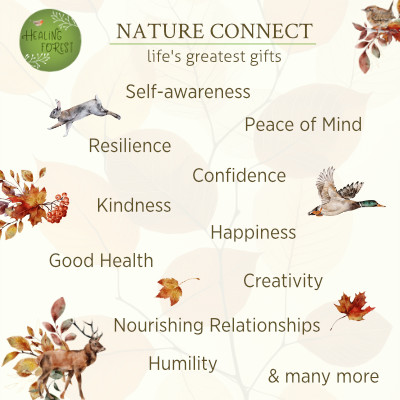
Nature Calm: For life’s greatest gifts.

Please do share this post where it’s needed.

To get useful new ideas and articles, join our free monthly newsletter.

When your mind is in a zoo, here’s a song to set you free. Our chaotic cities imprison us in cages disguised as cubicles, classrooms, cars, and captive screens. The web was meant to open the world for us, but even our phones have locked our attention into a small box. Is there a better way to live our life?

Only when you realize you are in a cage can you learn how to escape. Here’s a song to set you free. Keep this song with you as a memory. Whenever you hear it, you’ll remember. It’s time to free yourself.

Living in a city can be rough. If your head or heart is feeling trapped, you can always come home to the forest. There are many amazing gifts waiting for you to discover. Start your adventure with this article on the Japanese art of creating health and happiness with nature: FOREST BATHING

Also try our set of 10 magical walks to learn life’s most useful skills: Nature Play

Music connects cultures, but can it connect different worlds? I have used AI to create a music band with one animal from each continent (the penguins are still deciding.) The songs by Healing Forest band remind us to come back to the natural world, even if it is for a short while. We need nature in our lives.

Our forests need us too. Please download the song video and share it far and wide. Add this video to your social media presence and make a small difference. Feel free to use it as you please. (*A link back to our site would be deeply appreciated.)

WHY IS THIS USEFUL: Social media is filled with junk content, but when you create something meaningful they ask you to pay to promote it. This video was made to enable like-minded friends like you to add a little nature call into the digital world. Use it to remind people that there’s a wilder, freer world waiting just outside the cage.

~ Lyrics by
ND | healingforest.org

Lion song, was shot in Singapore. The name Singapore originates from the Malay word “Singapura” which translates as Lion City. The official mascot for Singapore is the Merlion, a mythical creature with the head of a lion and the body of a fish. Singapore is a beautiful, eco conscious place and is also known as the garden city. *This song is a reflection on the state of our human race and not an indicator of any particular country.

The birds and animals in the video are from Mandai Zoo and S.E.A Aquarium in Singapore. It features some extremely rare and endangered species. Some of the notable ones are: white cheeked gibbon, nicobar pigeon, and sea dragon. How many others can you spot?

The band members, and the hero our Lion song – Merlin (son of Merlion) were generated using Midjourney, KlingAI, and Runway ML. We used Suno to generate the song tune and it was put together using Davinci Resolve. Ai is enabling us to give a voice to these amazing wild creatures. Helping us tell uniques stories that can bring people back to nature.

Our small ‘Healing Forest’ band is getting ready to release more songs in the coming months. Leave a comment to let us know which topic you’d like us to make our next song on.

To find inspiring new nature stories, films, and activities you can check out our free monthly newsletter>>