
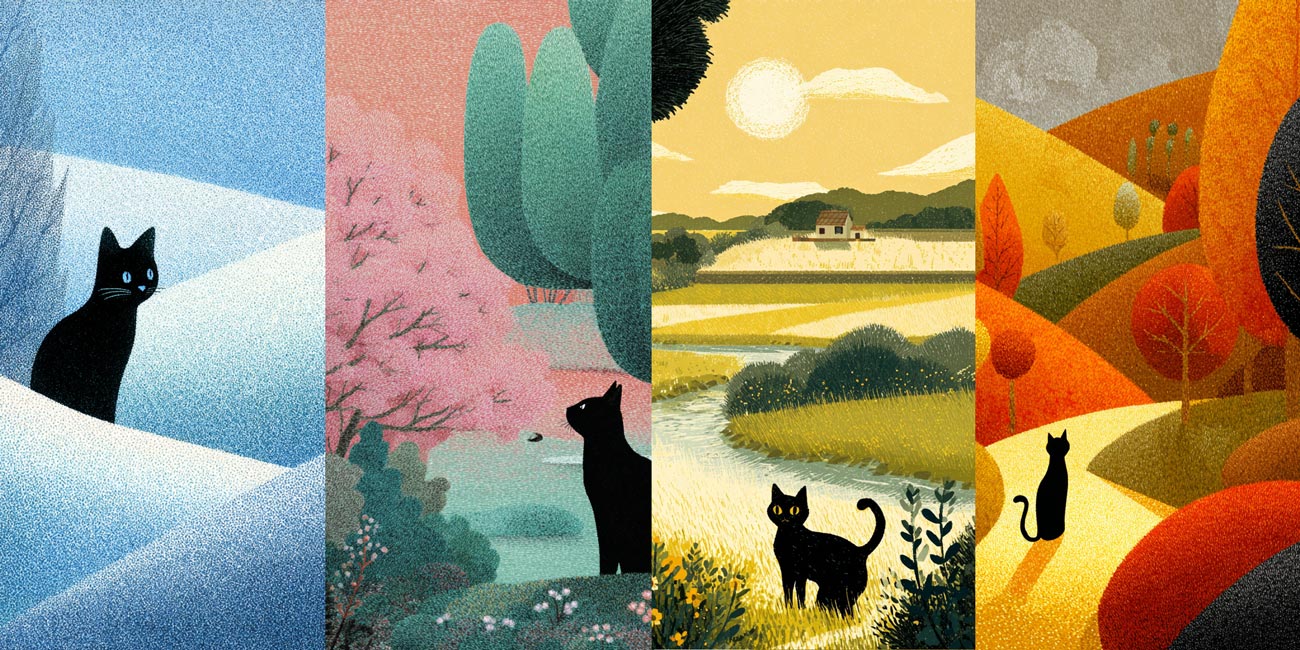
Seasons of Our Mind
The nature of human nature is a study of opposites. Our mind holds many worlds: light and shadow, peace and restlessness, hope and sorrow, love and indifference. To understand the nature of human nature it to observe how it shifts, the way it flows, and to know the seasons of our own mind. Our inner life is not a straight line but a cycle, full of rise and fall, fullness and emptiness.
In this article we will use the metaphor of seasons to create a useful study on the nature of human nature. Each section will also have simple meditations and creative activities to help you deal with the negatives and transform them into positive emotions.

As always, we save the best for the last. At the end of this post is a beautiful time-lapse film from Denmark and links to activities based on your current mood.
Nature and Human Nature
Just as the earth moves through winter, spring, summer, and autumn, so too does the human mind pass through its own quiet seasons. Understanding this can bring relief and each stage in nature comes with its own lessons. Every season carries both beauty and hardship. Winter can bring anxiety, but also calm. Spring may stir loneliness, but also love. When we see our emotions as part of a natural rhythm, we begin to meet them with less fear and more tenderness. It is also a great way of knowing and connecting with others.
In Buddhist tradition, there are four positive emotions that help us stay steady through these shifts: loving-kindness, compassion, joy in the happiness of others, and deep inner balance. These are not fleeting moods. They are conscious practices for our mind. Seeds we can grow. Through them, we learn not just to survive the seasons of the mind, but to live gently and wisely within them.

Winter: Turning Worry into Stillness
Winter arrives quietly, often without warning. It brings short days, long nights, and a hush that settles over the landscape of the mind. In this stage our mind may feel distant, uncertain, or burdened by thoughts we cannot quite name. Worry creeps in like a chill, subtle, persistent. Anxiety grows in the silence, asking questions we cannot answer: What if? What now? What next?
It is natural to want to escape this season. But winter asks something different of us. It invites us to pause.
Practice: Sitting with Equanimity
Find a quiet place and sit comfortably. Close your eyes and place one hand gently over your heart. Imagine you are a tall mountain with a snow storm falling on it. Breathe slowly, in and out.
As you breathe, say softly to yourself:
“This is a moment of calm.”
“I do not need to fix anything right now.”
“Storms come and go”
“In me is a mountain of stillness.”
Let your breath be like the snow steady, soft, enough.
In this simple presence, the mind begins to settle. Worry loosens its grip. The gift of winter is a quiet strength that does not depend on the world being warm or certain. This is equanimity, the balance that allows us to bend without breaking. It does not erase fear, but it teaches us to sit beside it, breathing.

Spring: Love, Longing, Loneliness
Spring arrives with warmth on its breath and green at its fingertips. There are times when our mind feels the pull toward connection, renewal, tenderness. Love awakens, not just for others, but for life itself. The heart softens. We smile more easily, feel more open, even hopeful. A bird’s song can move us. A kind word can open us. The world feels alive again, and so do we.
The negative aspect of spring, is the ache in our heart. We may feel lonely in the midst of blooming things. The thoughts might stir memories of what we’ve lost or never received. In the face of others’ joy, we may feel our own emptiness more clearly. Indifference from others, or even from ourselves. When love is not returned, or when we feel forgotten, spring can hurt.
Here’s a mindfulness activity to transform your inner nature.
Practice: Walking among trees
Take a walk where there are old trees. It could be a park, a forest path, or even a quiet street. Walk slowly, without hurry. Let your senses lead you. Feel the sunlight on your skin. Notice the sound of leaves in the breeze. As you walk, breathe gently and say to yourself:
“I am part of this world.”
“There is life in me.”
“I open my heart to what is here.”
Let the world around you remind you that you belong. That love is not only something you give or receive. It is something you are, simply by being alive.

Summer: Shifting Anger with Compassion
Summer in our mind doesn’t ask permission. It arrives in full force – bold, hot, loud. The mind, can grow heated. Emotions rise quickly. Anger flares. We feel stretched, reactive, easily burned by the words or actions of others. Even love can feel overwhelming, too bright, too much. We are swept into irritation or resentment. It is easy to feel caught in the fire of judgment, directed toward ourselves or others.
But summer also carries life at its peak. Life that is vibrant, abundant, generous. If we can soften into the heat rather than fight it, we begin to see what’s underneath the anger: a wounded part of us that longs to be heard. This is where compassion begins. Knowing that the Sun falls equally hard on everyone. Fire burns everything in its path.
To shift anger to compassion, first remove yourself from the place of extreme heat.
Practice: A meditation on compassion
Find a quiet space to sit. Place your hands gently in your lap. Take a few slow breaths.
Bring to mind someone who is suffering. It could be yourself, or another. Imagine them as a small child who is hurting. See their face, their posture. Gently repeat in your mind:
“May you be held in kindness.”
“May you be free from pain.”
“May you know peace.”
If it is yourself you are holding in compassion, let the words be directed inward. Imagine cooling rain falling gently on hot skin. Let compassion be the shade you rest in, a kindness that softens the harsh sun of anger.

Autumn: Sorrow and Joy
Autumn arrives with a softness that aches. There is beauty in this season, but also a quiet sorrow. We may feel a sense of ending. Things passing away, slipping through our fingers. Grief can surface here, sometimes from long ago, sometimes from yesterday. The mind may return to memories, to moments we wish we could hold just a little longer.
Loss of loved one gone, a change we didn’t choose, a chapter closing. In autumn, the heart feels this weight more clearly. It is a time of remembering, and sometimes of longing.
Yet even as things fall away, autumn surrounds us with color. The trees do not resist their own turning. They blaze in reds and golds, offering beauty even as they let go. In the midst of sadness, we find a quiet kind of joy: the joy of presence, of seeing clearly, of appreciating what is here now, before it fades.
This joy does not erase grief. It holds hands with it.
Practice: Colours of Gratitude
Go outside on an autumn day. Bring a small basket or simply your open hands. As you walk slowly, collect fallen leaves, each of a different color. Notice their shape, their edges, the way each one is perfectly itself. When you return, lay them out in front of you. Sit quietly and look at them. For each leaf you have collected, think of one thing that you are grateful for.
Breathe slowly and say:
“I welcome change.”
“I see beauty, even in endings.”
“I give thanks for this breath.”
“I give thanks for this moment.”
Let the colours remind you that even as things fall away, there is richness in the letting go. Joy, in this season, is not loud. It is the quiet warmth of knowing that you will be held by acts of kindness. Gratitude for small joys, will always be a part of our mind and your life.
Nature of Human Nature: Insight
To live is to move through seasons, not just around us, but within us. Joy and sorrow, calm and confusion, love and loneliness: all are part of the rhythm of being human. When we stop resisting these shifts, we can meet each one with mindfulness and compassion. We begin to see that none of it is wrong. It is simply life unfolding. This is the nature of human nature: ever-changing, deeply feeling, and always returning to balance, like the earth itself.
*To get useful new articles in your inbox once a month, join our free monthly newsletter.
What’s Your Nature?: As a playful exercise, ask yourself and your close friends a simple question: “What is the city or a geographical area on Earth that would best depict your mood personality?” For example: You could be a Florida, a Siberia or a Rio Di Janeiro.

REQUEST: Please share this post so it reaches those who may need it. We are a small group of friends trying to find new ways to reconnect people with nature. The aim is simple. Helping people heal. Helping forests heal.


 Healing Forest